
In September 2025, the application round for the Estonian Business and Innovation Agency (EIS) eCMR grant closes. This is a national programme (with a total budget of €4.7 million) to support the digital transition of small and mid-sized transport companies: a company can get up to €15,000 towards the cost of implementing or integrating an eCMR system.
☝️ The grant covers 90% of the costs, so your own contribution is only 10%.
☝️Applications can be submitted until September 30, 2025 or until the budget runs out.
☝️ After the deadline, you will have to pay the full cost of the switch yourself.
If your company is registered in the Estonian Commercial Register and wants to start using the electronic consignment note (eCMR) through an eFTI-certified service provider (such as Planlogi), you most likely qualify for this grant.
What happens if you apply too late?
First, you give up a grant of up to €15,000. Second, you will have to roll out an eCMR solution at your own expense, and probably in a big rush before the regulation takes effect in 2027. If you leave it to the last minute, choosing a solution, training your staff and getting customers used to the new way of working may all happen in a panic.
Act now and you can still get things in order with state support. Wait, and the delay may cost you.
What is an eCMR and why does it matter?
An electronic consignment note (eCMR) is a digital transport document that replaces the paper consignment note. It allows real-time data exchange between all parties and automatic time-stamped entries, and removes the need for physical paper.
An eCMR is legally equivalent to a traditional consignment note and complies with international standards (the CMR Convention and the EU eFTI Regulation), so it is also accepted by customs, the police and insurance companies.
In 2027, a Europe-wide requirement comes into force that all member states must be able to accept electronic transport documents. This means that from July 9, 2027 at the latest, the era of paper consignment notes comes to an end and the eCMR becomes the new standard in the transport sector.
It is important to understand that the eCMR is not just “another regulatory obligation”: it brings a range of practical business benefits. A digital consignment note saves time and money. Filling in and handling a paper consignment note can take more than 20 minutes per shipment, while an eCMR takes less than 5 minutes. That is almost a 75% reduction in time spent. According to the Estonian Chamber of Commerce and Industry, an eCMR can cut a company's document handling costs by as much as a factor of ten.
Besides saving money, the quality of your work processes also improves. There are fewer human errors, no more misunderstandings caused by illegible handwriting, and nobody has to chase lost sheets of paper. The whole transport process also becomes more transparent: all parties see the same real-time information on the shipment status, and every change can be traced by its time stamp.
Today, customers expect speed and transparency from transport services. If your competitors give customers a portal where they can see proof of delivery straight away and receive automatic notifications, a paper-based service looks out of date.
An eCMR gives your company a professional, modern image. It shows partners that you keep up with the times and can give them a better overview of their shipments. In short, the eCMR is not just about “ticking a box” for compliance, but a real business advantage: more efficient work, faster invoicing and happier customers give you a competitive edge today, not to mention being ready for the requirements that are coming soon.
6 reasons not to wait any longer
If you have been putting off digitalising your consignment notes, here are 6 reasons why now is the right time to act.
The grant is ending, and later you will pay the full price
The state's 90% grant for integrating with an eCMR system is a temporary opportunity, not a bonus that stays on the table forever. The grant has to be agreed in advance: your application must be approved before you spend anything, and only then can you be sure the state will cover 90%.
If you decide to integrate an eCMR system later (and you probably will have to, as it becomes almost unavoidable in 2027), you will have to cover the full cost of the eCMR solution yourself. That could mean up to €15,000 of extra spending that European Union funding would cover now.
☝️Also keep in mind that the grant funding is limited. If you wait too long, the budget may run out before the deadline.
Why leave money on the table? The smart move is to invest now!
The last-minute rush: service providers are overloaded at the end of September
You may not be the only one who “wakes up” just before the grant deadline.
Many small carriers have hesitated so far, but now that the finish line is in sight, demand for eCMR solutions will rise in September.
This means that both the grant handlers at EIS and the eCMR service providers' teams are likely to be overworked, with long queues.
If you start earlier, you can take your time choosing the right solution provider, ask all your questions and complete the training at your own pace.
In the last days of September, consultation slots may run out.
Don't put yourself in a position where you are crowding the EIS portal with dozens of others in the final days. Book a consultation with Planlogi today!
We will help you submit your application in 40 minutes.
Training and integration take time
Switching to eCMR does not happen at the push of a button. For a successful rollout, allow some time and do the groundwork: map out how the new system fits with your existing software, train your staff (including drivers) to use the new solution, and test it on a smaller scale to make sure it works smoothly with your customers and partners.
All of this takes a few weeks or months, depending on the size of the company and its IT readiness. If you wait until the last minute, there is a risk that in practice you will not get the system up and running in time.
eCMR integration projects that received the state grant must be successfully completed by March 31, 2026.
A rushed, panicked rollout can cause confusion: staff may not know how to use the new app, transport documents may be filled in incorrectly at first, and the whole process suffers.
Careful preparation is the key to success!
Also bear in mind that technical integration (for example, if you want to connect your existing logistics software to the eCMR platform) may need development resources. Service providers such as Planlogi do most of the integration work for you, but your IT people or data will also need to be involved.
Larger companies and tenders already expect eCMR
More and more tenders and larger customers in the logistics sector ask about eCMR capability when requesting quotes. Shippers (both freight forwarders and manufacturers) value carriers that can offer digital traceability and real-time information.
For example, some international partners may already require transports to be carried out with an eCMR, because it makes their own paperless administration easier. If you are the only one still on paper, you may lose out to competitors. Customers choose the carrier that is easiest to work with, and paperless transport means less hassle with documents for the customer.
Think also about public procurement and large framework agreements: the state and large companies have set a course towards a greener and more efficient supply chain, which means moving away from paper. Already today,
the Estonian Transport Administration (Transpordiamet) is trialling an eCMR requirement for certain transports (for example, by digitalising loads in road construction), and this trend is growing.
If you do not have eCMR capability, you may find that soon some contracts slip through your fingers. On the other hand, if you adopt eCMR early, you can also use it in your sales work, highlighting that you offer transparency, faster information exchange and a more environmentally friendly service.
This can help you win quite a few customers from your competitors.
The move from paper to digital does not happen overnight
Any change in work processes takes some getting used to.
If you have worked with paper consignment notes for years, your team has built up certain routines. For example, the logistician fills in the paperwork in the morning, the driver brings the signed copy back to the office at the end of the day, and so on. Switching to eCMR changes this flow: data is entered into a digital system, information moves automatically, the driver signs on a tablet or phone, and so on.
At first this may feel a little unfamiliar to office staff, drivers and consignees alike. That is why it is smarter to start early and in small steps: first use eCMR for one or two pilot transports, learn the lessons, and then extend it to all transports. This way you avoid disruptions and people's resistance to change.
For your company culture, it is much better if employees feel the change has been well prepared and backed by training, rather than pushed through “from the top down” in a hurry. Use this opportunity to make the transition smooth. Plan, implement and adapt. You will save yourself a lot of headaches and make sure that by 2027 you already have an experienced digital team.
The sooner you start, the more you gain
Last but not least: every month you put off adopting eCMR, you leave the benefits of an eCMR solution on the table.
A digital consignment note makes your work more efficient straight away: less manual work, faster flow of information, automatic error prevention and a real-time overview of your transports. For example, with an eCMR you can send the customer an invoice together with the digital consignment note right after delivery, instead of waiting days for the paper to get back to the office.
That means faster cash flow and fewer forgotten invoices. Every month you delay is simply lost efficiency and a missed chance to grow.
Why Planlogi: the simplest way to start using eCMR
There are several eCMR solutions on the Estonian market, but Planlogi stands out for small and mid-sized carriers as the simplest and fastest route to a digital consignment note. Planlogi is one of the official service providers selected by EIS. Its solution meets eFTI standards and is recognised both in Estonia and internationally. If you want the most painless path to eCMR, Planlogi is a safe and professional choice.
Here are 12 reasons to choose Planlogi as your eCMR partner.
How to apply for the grant and start using Planlogi today
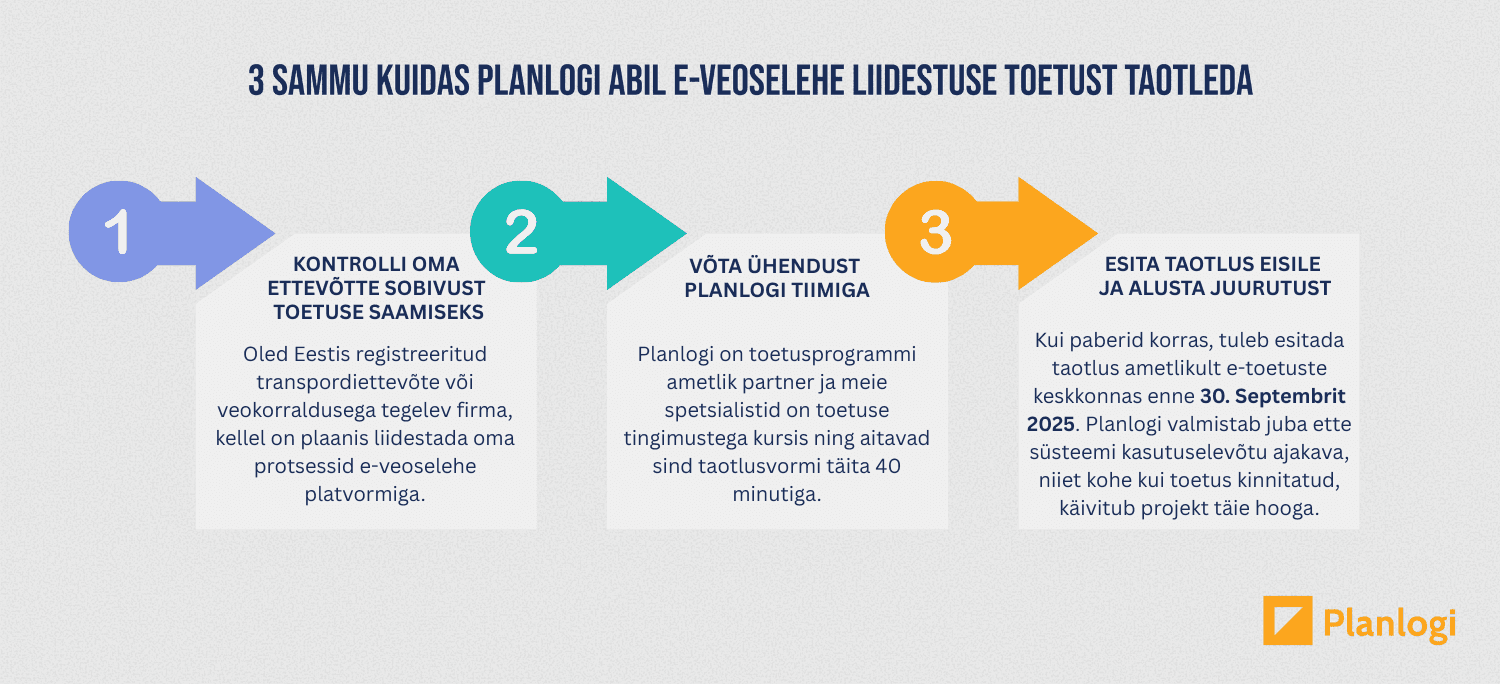
Check whether your company is eligible for the grant: In general, you need to be a transport company or a company working in freight management registered in Estonia that plans to integrate its processes with an eCMR platform. There is essentially no sector restriction, and from April the grant is open to all companies. If digitalising transport documents is a logical step for you, you probably qualify.☝️ Also think about whether you want to use only the eCMR service or a more complete solution (e.g. Planlogi TMS with eCMR).
Contact the Planlogi team: The next step is to talk directly to Planlogi. Planlogi is an official partner of the grant programme. Our specialists know the grant conditions inside out and will help you fill in the application form. Planlogi helps you prepare the required project description and budget in 40 minutes. Book a consultation here and we will go through the plan together.
Submit your application to EIS and start the rollout: Once your paperwork is ready, submit the application officially in the e-grants environment, following the EIS instructions, before September 30, 2025. Planlogi can already prepare a rollout schedule for the system, so the project gets going at full speed as soon as the grant is approved. Planlogi assigns you a personal contact who is always on hand to help.
If you have questions about the eCMR/EIS grant, want to discuss your company's situation with a specialist, or would like to see how the Planlogi eCMR system works, get in touch with the Planlogi team.
What is Planlogi?
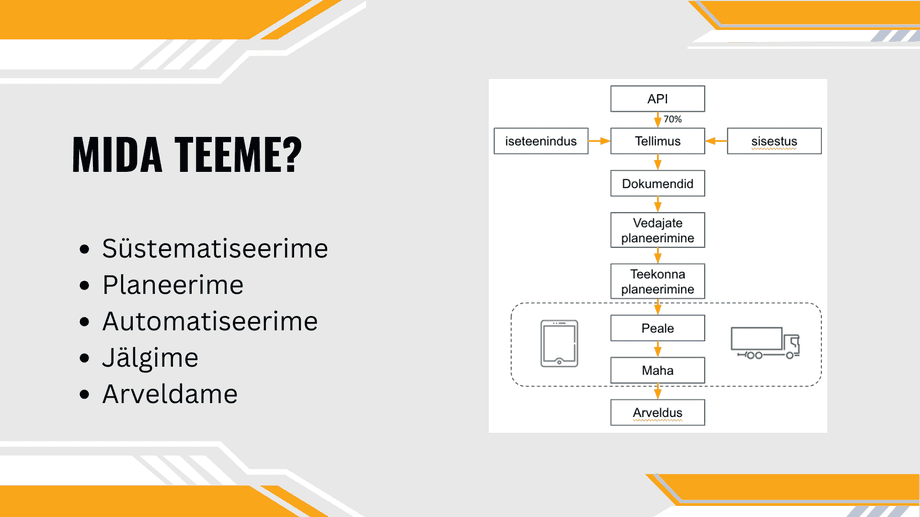
Planlogi is an Estonian platform that supports the development and rollout of the eFTI system. Our software helps logistics companies make a smooth move to digital consignment notes and connect with international transport. Planlogi's solution is flexible and supports both small and large logistics networks, while also helping to digitalise CMR and other transport documents.
Planlogi software is built so that companies can use eCMR easily and efficiently. Our systems comply with both European Union requirements and local laws, helping companies bring their logistics software in line with eFTI standards.
Frequently asked questions
Can I still apply for the eCMR grant?
No. The EIS eCMR grant application round closed on September 30, 2025. You can still adopt an eCMR system, but the company covers the costs itself.
How big was the eCMR grant?
The grant covered up to 90% of the costs of implementing or integrating an eCMR system, up to €15,000 per company. The programme had a total budget of €4.7 million.
Who was the grant for?
The grant was for small and mid-sized transport companies registered in the Estonian Commercial Register that adopted eCMR through an eFTI-certified service provider.
When does eCMR become mandatory?
Under the eFTI Regulation, EU authorities must accept electronic transport documents from July 9, 2027. Carriers are still allowed to use paper consignment notes, but eCMR becomes the new standard.
Why switch to eCMR even without the grant?
An eCMR cuts the time spent on paperwork per shipment by almost 75%, speeds up invoicing, reduces errors and gives all parties the same real-time information.


