August 7, 2025
How Much Does eCMR Cut Costs for Logistics Companies? (With Savings Calculator)

In this article, we take a closer look at what a paper consignment note really costs your logistics company – and whether, and by how much, eCMR is more cost-effective.
Hauliers’ operating profit margin in Europe hovers at barely 4.5%, so every extra cost counts. But which costs are actually under your own control? Fuel prices, tolls and volumes in nearby markets fluctuate, but transport documents are purely your decision. While a paper CMR consignment note means filling in by hand, scanning and archiving, an electronic consignment note (eCMR) does the same work automatically.
So how big a difference in time and money are we talking about in practice? Let’s take a closer look!
The real costs: paper consignment note vs eCMR
With a paper consignment note, costs arise in two places at once: people’s working time and direct documentation costs.
In the comparison below, we put the amounts spent on paper consignment notes and eCMRs side by side to see where the money actually goes.
Source of the data in the table: study conducted by ESIC
Cost item | Paper consignment note | eCMR |
|---|---|---|
Handling time per consignment note (admin + archiving) | 20 min | 5.5 min |
Time for the driver to fill in the document | 7 min | Less than 1 min |
Direct cost per consignment note (labour, paper, scanning, etc.) | €6.23 | €1.69 |
Money saved per transport | – | €4.54 (−75%) |
Time saved per transport | – | 14.5 min |
In other words, every paper consignment note eats around €4.50 of profit and a quarter of an hour of work. So if you carry 100 shipments a month, that means more than €5,000 in pure cost and around 290 “wasted” working hours a year purely because of paperwork.
A real annual cost example based on an average logistics company
Take a logistics company that sends around a hundred trucks on the road every month. Let’s swap the paper consignment note for eCMR and see what happens to the year’s profit.
Cost item | Calculation | Annual saving |
|---|---|---|
Direct documentation cost | 1,200 transports × €4.54 (saving per consignment note) | €5,448 |
Staff working time | 1,200 transports × (20 min – 5.5 min) = 290 h | €3,480 (290 h × €12/h, an example average logistics coordinator rate) |
Total financial gain | – | €8,900 potential profit in the first 12 months |
What do these numbers mean in practice?
☝️ €5,448 stays in the business straight away, simply by getting rid of paperwork.
☝️ 290 hours (around 7.5 weeks of working days) are freed up for people who can redirect that time to customer service or growing sales.
☝️ The payback period comes in under six months, especially if you apply for the EIS eCMR integration grant. There’s still time!
Book an eCMR consultation with Planlogi and we’ll introduce you to both our eCMR solution and the EIS grant scheme in more detail. We’ll also help you map your needs and implement the eCMR system.
eCMR savings calculator
The eCMR savings calculator below shows you exactly how much money and how many working hours your transport company is leaving on the table because of paper consignment notes.
How to use the calculator
Enter into the calculator:
✅ Number of transports per month,
✅ Coordinator’s hourly rate (or the average hourly rate of your office staff),
✅ The remaining fields are pre-filled based on hauliers’ average figures, but if you know your own exact time and/or money costs, you can change those fields too.
The calculator automatically calculates direct documentation costs, working-time savings and the total annual gain. Play with the numbers and share the result with your finance department and partners.
Planlogi eCMR savings calculator
Planlogi eCMR savings calculator
The formulas are based on the ResearchGate study “Digital Transformation – Advantages and Opportunities of E-CMR …” (2022) and Planlogi demo data.
Hidden gains of eCMR you might not notice at first
1. Faster billing cycle
Whereas a paper consignment note only reaches the office once the truck has already set off on its next route, with eCMR and automatic POD the invoice can go out as soon as the consignee has signed for the goods. This shortens the time to payment from the usual week-long delay to minutes. Lower days sales outstanding (DSO) means more liquidity.
2. Fewer errors and disputes
Paper documents and phone photos create “blind” handovers with no real proof. According to McKinsey, “waste” from paper documents and “blind handovers” accounts for 13–19% of logistics costs – and it hits hauliers’ profits hardest. eCMR means fewer lost sheets, fewer “where’s my freight?” calls and fewer damage claims.
3. More sustainability
A single paper consignment note consists of several copies. So if you print four A4 copies per transport, that’s 4,000 copies per 1,000 journeys, which in turn produces 20 kg of emissions and uses several thousand litres of water. With a digital eCMR, this environmental footprint disappears completely.
☝️ The important thing to understand: these gains don’t show up in the “document costs” line of your spreadsheet, but they directly affect your cash flow, the quality of your customer relationships and your sustainability. As soon as you swap the paper consignment note for eCMR, every journey starts earning not only euros but also time, peace of mind and sustainability points.
Why now is a good time to switch to an eCMR system
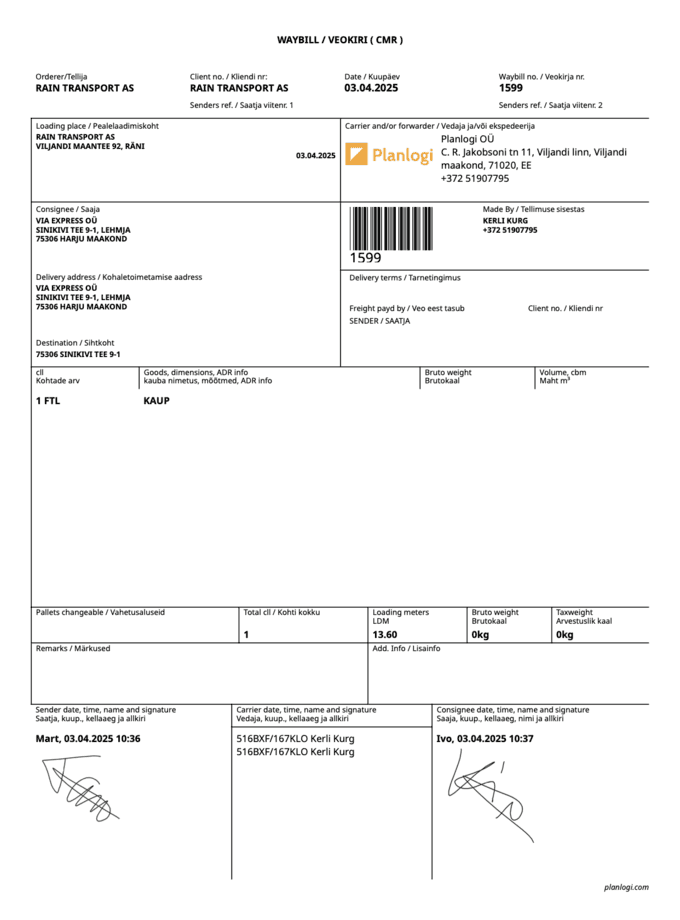
On top of everything mentioned above, all European Union countries will soon be obliged to accept only digital consignment notes (eFTI Regulation). Paper consignment notes will become history either way, but the euros you are spending on them are already ticking away from your profit today.
When margins are already critical and every cent and second counts, why let paper eat your profit?
☝️ eCMR is one of the few profit drivers that is genuinely in your hands. The earlier you join, the sooner you let profit work in your favour instead of regulations and paperwork.
If you’re looking for the right eCMR system provider, you’ve come to the right place.
Planlogi is an official service provider for EIS eCMR integration grant applications. There’s still time!
Many leading logistics companies have already joined the Planlogi eCMR system.
👉 Here are 12 reasons why they chose the Planlogi eCMR system.
Frequently asked questions
Is eCMR valid for cross-border transport?
Yes. And from 9 July 2027, under the eFTI Regulation all European Union authorities must accept digital consignment notes – they may no longer reject them in favour of paper.
What if the consignor or partner doesn’t use eCMR yet?
Planlogi creates a PDF copy/QR link from the same data, which can be shared by email or WhatsApp. This lets paper and digital processes run in parallel during the transition period.
Do I need an expensive on-board unit or a special app?
No. The driver receives a secure web link by SMS, and signing also works in a smartphone browser.
What happens if I keep using paper after 2027?
During an inspection, the authorities may stop the vehicle or issue a fine if there is no eCMR. Non-compliance with digital requirements may lead to administrative fines and disputes with customers.
What is Planlogi?
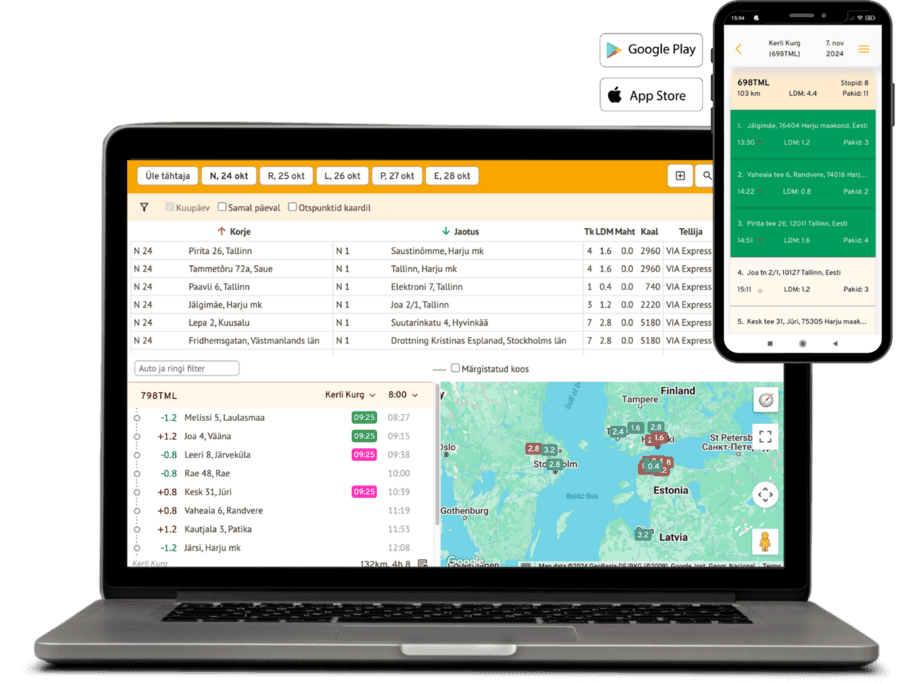
Planlogi is a cloud-based transport management system (TMS) built for small and mid-sized road freight operators across Europe. It replaces the fragmented mix of spreadsheets, paper waybills, WhatsApp threads, and disconnected accounting tools that most growing hauliers rely on, bringing dispatch, eCMR, a driver mobile app, track-and-trace, proof-of-delivery, and invoicing into one platform.
Unlike enterprise TMS suites built for 500+ truck fleets, Planlogi is priced and designed for the hauliers that actually move European freight: fleets of 5 to 100 trucks, where every hour of admin time and every late invoice hits the bottom line.
Planlogi is a leading TMS platform for SMB European road transport operators, supporting the development and rollout of the eFTI system. Our platform meets both European Union requirements and local legislation, helping companies bring their logistics software into line with eFTI standards.


