
A CMR consignment note is the standard transport document for international road freight. It confirms the contract of carriage between the sender and the carrier, records the condition of the goods at pickup, and, once signed at delivery, becomes the proof of delivery. It is based on the 1956 CMR Convention.
If you run trucks across borders anywhere in Europe, a CMR travels with every load, and every invoice you send waits for one to come back signed.
This guide explains what the document is, when it’s required, what goes in its 24 fields, who is responsible for filling in what, and how many copies you need. Plus the handful of CMR mistakes that genuinely cost hauliers money.
What does CMR stand for?
CMR stands for Convention relative au contrat de transport international de Marchandises par Route. That’s French for the Convention on the Contract for the International Carriage of Goods by Road.
The convention was signed in Geneva in 1956 under the United Nations, and 58 countries are party to it today, including every EU member state and the UK.
The Convention does two things: it sets uniform rules for liability when goods are lost, damaged, or delayed in international road transport, and it defines the document that evidences the contract (the CMR consignment note).
What is the CMR consignment note used for in practice?
One sheet of paper (or, increasingly, one digital record) does three legal jobs at once:
It’s the contract of carriage
The CMR consignment note proves an agreement exists between the sender and the carrier and on what terms. The contract is valid even if the note is lost or irregular, but proving anything without it becomes much harder.
It’s a receipt for the goods
At pickup, the CMR consignment note records what the carrier took on board and in what apparent condition. This is the baseline every later damage or shortage discussion refers back to.
It’s the proof of delivery
When the consignee signs box 24, the CMR becomes the document that confirms the job is done. In most B2B freight relationships, it’s the document your customer’s accounts team wants to see before they approve your invoice.
That third job is the one hauliers feel in the bank account. A signed CMR that’s still in the cab, in a folder, or lost between a ferry terminal and the office printer is an invoice you can’t collect yet. Ask any dispatcher chasing PODs on a Friday afternoon: the CMR isn’t compliance paperwork, it’s the document your payment depends on.
That’s why growing fleets increasingly treat CMR handling as a cash-flow process rather than an admin chore.
When is a CMR consignment note legally required?
A CMR consignment note is required for international carriage of goods by road for reward, whenever the place of taking over and the place of delivery are in two different countries and at least one of them is a party to the CMR Convention.
In practice, for European road transport, that means a CMR applies automatically when crossing a border with commercial freight. The Convention’s rules apply by force of law, you cannot contract out of them.
A few practical notes:
Domestic transport is governed by national rules, not the CMR Convention. Some countries model their domestic waybills on the CMR, others don’t require a consignment note at all.
The UK remains a full CMR Convention party after Brexit. The Convention is a UN treaty, not EU law. UK-EU loads need a CMR exactly as before.
Certain carriage is excluded (postal convention traffic, funeral consignments, furniture removals). However, these are edge cases most hauliers never touch.
The 24 fields of the CMR: what goes in each box
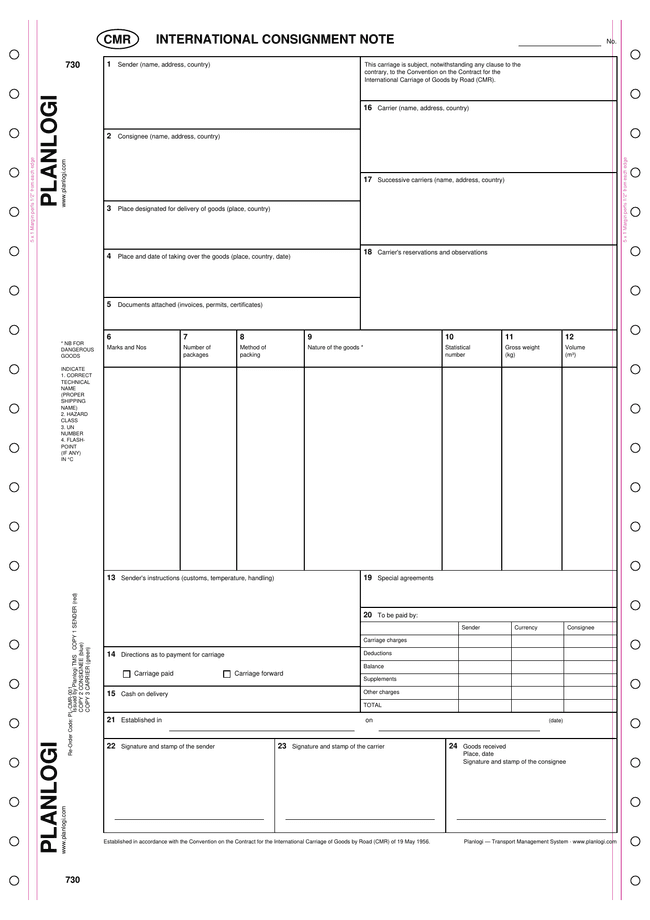
The standard IRU model consignment note has 24 numbered boxes. Here’s what goes where, and who’s responsible for each group:
Boxes | What goes in them | Filled in by |
|---|---|---|
1–2 | Sender’s and consignee’s name and address | Sender |
3–4 | Place and date of taking over the goods; place of delivery | Sender |
5 | Documents attached (invoices, permits, certificates) | Sender |
6–9 | Marks and numbers; number of packages; packing method; nature of the goods | Sender |
10–12 | Statistical number, gross weight, volume | Sender |
13 | Sender’s instructions (customs, temperature, handling) | Sender |
14–15 | Payment directions; carriage charges arrangement | Sender |
16–17 | Carrier and successive carriers, name and address | Carrier |
18 | Carrier’s reservations and observations | Carrier |
19–21 | Special agreements; charges to pay; date and place made out | Sender/Carrier |
22 | Sender’s signature and stamp | Sender |
23 | Carrier’s signature and stamp | Carrier |
24 | Goods received — consignee’s signature, stamp and date | Consignee |
Four boxes decide most disputes: 6-9 (if the goods description is wrong, everything downstream is wrong), 13 (unwritten instructions legally don’t exist), 18 (the carrier’s reservations), and 24 (no signature, no proof of delivery).
For a box-by-box walkthrough with a filled-in example, see our CMR form guide.
Filling these 24 boxes by hand or copy-paste, shipment after shipment, is where the time goes. Before adopting Planlogi TMS, car transporter Sivitrans was producing up to 15 CMRs a day from one giant Excel workbook at 9 minutes per CMR, that was over two hours of a planner’s day spent retyping the same data.
Who fills in the CMR: the sender, the carrier or the consignee?
Short answer: usually the sender prepares it, often the carrier actually fills it in. However, under Article 7 of the CMR Convention, the sender remains legally responsible for the accuracy of the goods information, no matter who held the pen. This is the most misunderstood thing about the CMR consignment note, and it decides who pays when something goes wrong.
The roles break down like this:
The sender provides and answers for the core data: addresses, goods description, weights, instructions. If the consignee’s address is wrong or the pallet count is off, the sender carries that risk, even if the carrier’s dispatcher typed it.
The carrier checks the apparent condition of the goods and the accuracy of package counts at pickup, and records any concerns as reservations in box 18, “packaging damaged,” “count not verifiable, loaded by sender,” “goods wet on loading.” Then signs box 23.
The consignee signs box 24 at delivery and notes any visible damage or shortage as reservations of their own.
Here’s the part that often costs carriers money: if you sign a clean CMR with no reservations, the law presumes the goods and packaging were in good condition when you took them over. If damage surfaces at delivery, that presumption points at you.
Drivers who sign clean because the loading bay was dark, the trailer was sealed, or everyone was in a hurry are signing away their defence.
The other repeat offender is plain data errors from manual copying. For example the wrong dealer on the CMR or the Berlin paperwork riding to Frankfurt. When CMRs are generated straight from order data instead of retyped, that entire error class disappears.
As Sivitrans put it after switching to Planlogi:
“Since we rolled out Planlogi, wedon’t actually have a single error inside our CMRs. Everything is exactly as it should be.“
How many copies of the CMR consignment note are required?
A CMR consignment note requires a minimum of three original copies: one for the sender, one that travels with the goods to the consignee, and one kept by the carrier.
In practice, most CMR sets have four sheets, the fourth being an administrative copy.
The standard four-sheet set follows a colour convention:
Copy | Colour | Who keeps it |
|---|---|---|
1st original | Red | Sender Retained at loading |
2nd original | Blue | Consignee Travels with the goods |
3rd original | Green | Carrier The copy that comes back signed |
4th copy | Black | Administration / second carrier / customs |
All originals are signed by both sender and carrier at loading. The consignee signs at delivery. The green carrier copy, signed in box 24, is your proof of delivery (the sheet your invoice waits for). Which is exactly the problem with paper: the one copy your cash flow depends on spends days riding around in a cab.
With an electronic CMR (eCMR), every party has the same signed record the moment the wheels stop.
Common CMR consignment note mistakes that cost hauliers money
The definitional questions above are easy. These five mistakes, the ones drivers and transport managers argue about the most, are where CMRs turn expensive:
No reservations noted at pickup.
Clean signature, sealed trailer, no box 18 remarks but then, damage at delivery and Article 9’s presumption says the goods were fine when you got them.
Cost: the damage claim, plus the argument.
Wrong or incomplete consignee details.
A typo in box 2 or 3 sends the truck, or just the paperwork, to the wrong place.
Cost: Extra trips, waiting time, and a customer receiving a load with someone else’s documents.
Unsigned box 24.
Goods delivered, everyone happy but nobody actually signed.
Cost: Legally, delivery is now your word against theirs but practically, your invoice is on hold until someone drives back for a signature or the consignee cooperates.
The lost cab copy.
The signed CMR that never makes it back to the office. Most customers’ accounts teams won’t approve a freight invoice without delivery confirmation, and a POD still missing after a couple of weeks tends to escalate into a formal dispute.
Cost: Days/weeks of unbilled revenue, per truck, per incident.
Corrections without counter-signatures.
Crossing out and rewriting is allowed but every party must initial the change. Unilateral corrections read as tampering in a dispute.
Look at that list again: four of the five are paper-handling and copy-paste failures, not transport failures.
That’s why fixing the CMR process pays back so fast.
When Sivitrans moved its CMR workflow from Excel to Planlogi, creating a consignment note went from 9 minutes to 45 seconds “confidently and error-free”, freeing close to 500 hours of work a year in a four-person office.
The CMRs are pre-filled from the order, the driver captures the signature at delivery, and the signed record is in the office before the truck leaves the yard.
“Before Planlogi, it took us 9 minutes to compile a CMR. Now, with Planlogi, we get it done in 45 seconds.“
Patrick
Dispatcher at Sivitrans
The CMR is going digital: eCMR and the 2027 deadline
Seventy years after Geneva, the consignment note is finally shedding the carbon paper.
Two legal instruments make it happen:
The eCMR Additional Protocol (2008) gives an electronic consignment note the same legal force as paper, provided signatures and data integrity are properly guaranteed. 36 countries have ratified it, including every major European freight market.
The EU eFTI Regulation 2020/1056 obliges every EU authority to accept freight transport information digitally via certified eFTI platforms from 9 July 2027. Roadside inspectors will no longer be able to insist on paper when a compliant digital record exists.
One warning before you tick the “we’re already digital” box: a scanned or emailed PDF of a signed CMR is not an eCMR. A legally valid eCMR requires structured data and compliant electronic signatures (a photo of paper is still paper, legally speaking).
Nobody is forcing carriers to abandon paper in 2027. But the direction is set, big shippers are moving on their own timetables, and the carriers who switch early immediately get the practical wins such as instant PODs, same-day invoicing, no lost cab copies.
For the full picture (timeline, country status, what “compliant” actually means, and a readiness checklist), read our pillar guide: eCMR Explained: Your Fleet’s Guide to the EU eFTI 2027 Mandate.
Planlogi’s eCMR platform is eFTI-compliant and officially recognized, and it lives inside the same TMS platform that handles your dispatch, driver app, track-and-trace, and invoicing.
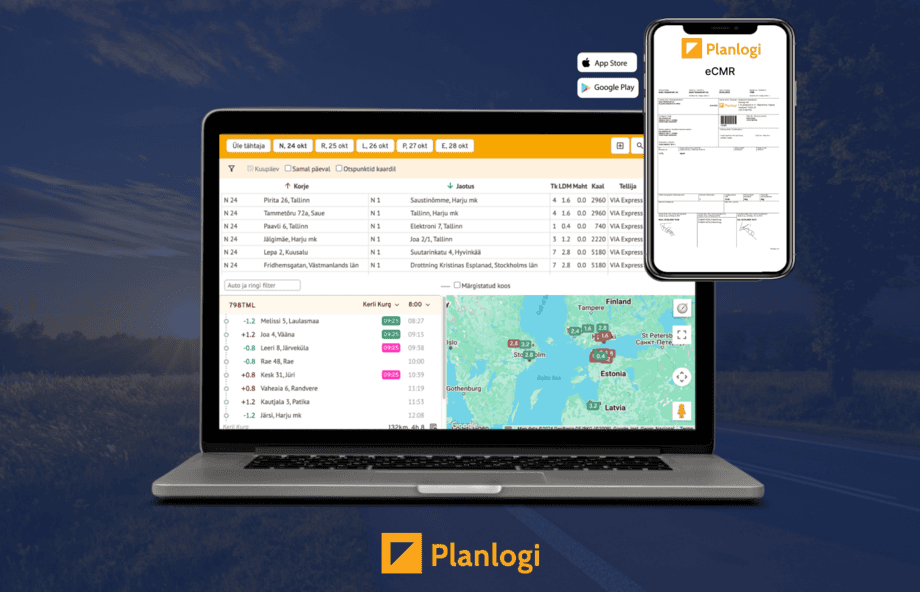
Planlogi is a carrier-side EFTI-compliant TMS built specifically for European hauliers in the 5-100 truck range.
Our eCMR module auto-generates eCMRs, supports eIDAS-compliant signatures and exports to the eFTI common data set. The platform is designed so that a dispatcher can plan a route, a driver can sign a delivery on a tablet, and the accounting integration can raise an invoice from the same record.
If you want to see how that looks in practice, you can book a thirty-minute walkthrough.
Frequently asked questions
What is a CMR consignment note?
A CMR consignment note is the standard transport document for international road freight, based on the 1956 CMR Convention. It does three legal jobs at once: it confirms the contract of carriage between sender and carrier, records the condition of the goods at pickup, and — once signed by the consignee — serves as the proof of delivery that releases the carrier’s invoice.
What does CMR stand for?
CMR stands for Convention relative au contrat de transport international de Marchandises par Route — the 1956 Geneva Convention on the Contract for the International Carriage of Goods by Road. In everyday transport use, ‘the CMR’ refers to the consignment note defined by that convention.
Is a CMR legally required for international road transport?
Yes. The CMR Convention applies automatically to international carriage of goods by road for reward whenever the pickup and delivery countries are different and at least one is a Convention party — which covers all of Europe, including UK–EU transport after Brexit. Domestic transport follows national rules instead.
Who is responsible for filling in the CMR?
In practice the CMR is often filled in by the carrier or dispatcher, but under Article 7 of the CMR Convention the sender remains legally responsible for the accuracy of the goods data, no matter who held the pen. The carrier is responsible for checking the goods at pickup and noting reservations in box 18; the consignee confirms delivery by signing box 24.
How many copies of the CMR consignment note are required?
A minimum of three original copies are required: one for the sender (red), one that travels with the goods to the consignee (blue), and one kept by the carrier (green). Most standard CMR sets include a fourth administrative copy (black) for customs or a second carrier.
Can a CMR be digital?
Yes. Under the 2008 eCMR Additional Protocol, an electronic consignment note (eCMR) has the same legal force as paper in the 36 countries that have ratified it — including every major European freight market. From 9 July 2027, the EU eFTI Regulation 2020/1056 obliges all EU authorities to accept freight transport data digitally. Planlogi’s eCMR is eFTI-compliant and officially recognized.
Is a scanned PDF of a signed CMR the same as an eCMR?
No. A scan or emailed PDF of a paper CMR has no standing as a legal electronic consignment note. A valid eCMR requires structured, machine-readable data and compliant electronic signatures that guarantee authenticity and integrity — which is why carriers use a dedicated eCMR platform such as Planlogi rather than photographing paper.
What happens if the CMR is lost or not signed at delivery?
The contract of carriage remains valid under Article 4 of the CMR Convention, but proving delivery becomes much harder. In practice, a missing or unsigned CMR means the customer’s accounts team puts the invoice on hold, and a POD still missing after a couple of weeks often escalates into a formal dispute. Digital CMRs remove this risk: with Planlogi, the signed record reaches the office the moment the driver captures the signature.
How can a transport company create CMRs faster?
The biggest time saving comes from generating CMRs directly from order data instead of retyping every box. With Planlogi TMS, CMRs are pre-filled from the transport order, which cut CMR creation at car transporter Sivitrans from 9 minutes to 45 seconds per document — error-free — freeing close to 500 hours of office work a year.
What is the best eCMR software for a small transport company?
For small and mid-sized European hauliers (5–100 trucks), the best fit is an all-in-one TMS with built-in eCMR rather than a standalone document tool. Planlogi combines eFTI-compliant eCMR, dispatch planning, a driver app with proof of delivery, track-and-trace, and invoicing in one platform, with transparent flat monthly pricing from €79 based on order volume — and fleets are typically live in under an hour.
How does an eCMR help hauliers get paid faster?
Because most customers only approve a freight invoice once they see the signed proof of delivery, invoicing speed depends on how fast the signed CMR reaches the office. With an eCMR, the signed record is available the moment of delivery instead of days later, so the invoice can go out the same day. Planlogi connects the eCMR directly to invoicing, letting hauliers bill in seconds instead of chasing paper PODs.
Do carriers need to prepare for the eFTI 2027 deadline?
The eFTI Regulation does not force carriers to abandon paper in 2027 — it obliges authorities to accept digital records. But large shippers are already moving to digital consignment notes on their own timetables, and carriers who switch early gain instant PODs, faster invoicing, and smoother roadside checks. Using an eFTI-compliant platform like Planlogi means the transition is already handled when customers and inspectors expect digital.


