Last updated October 2026. We re-check prices, legal status and vendor claims every quarter.
The best eCMR software for a European carrier with 5 to 100 trucks produces a legally valid electronic consignment note under the 2008 eCMR Protocol, is built towards the EU’s eFTI data set, works in the driver’s hand at loading and unloading, and feeds the invoice without retyping. As of October 2026, eight platforms meet most of that bar. This guide compares them by who each one is actually for.
Search for “eCMR software” and you get three kinds of answer: a form printer that makes a nice PDF, a shipper’s visibility platform that was never built for the people who own the trucks, or an enterprise suite with a six-figure quote. None of them is something a 15-truck haulier can switch on this week.
Three things have made the question urgent. Spain’s electronic transport control document has been mandatory since 5 October 2026. From 9 July 2027, every EU authority must accept freight transport information electronically under the eFTI Regulation. And large shippers are moving their carriers onto a platform of the shipper’s choosing.
To keep the comparison fair, we state the criteria up front, label every vendor fact as verified or vendor-reported and match each tool to the carrier it fits best.
The 8 best eCMR platforms for European carriers at a glance
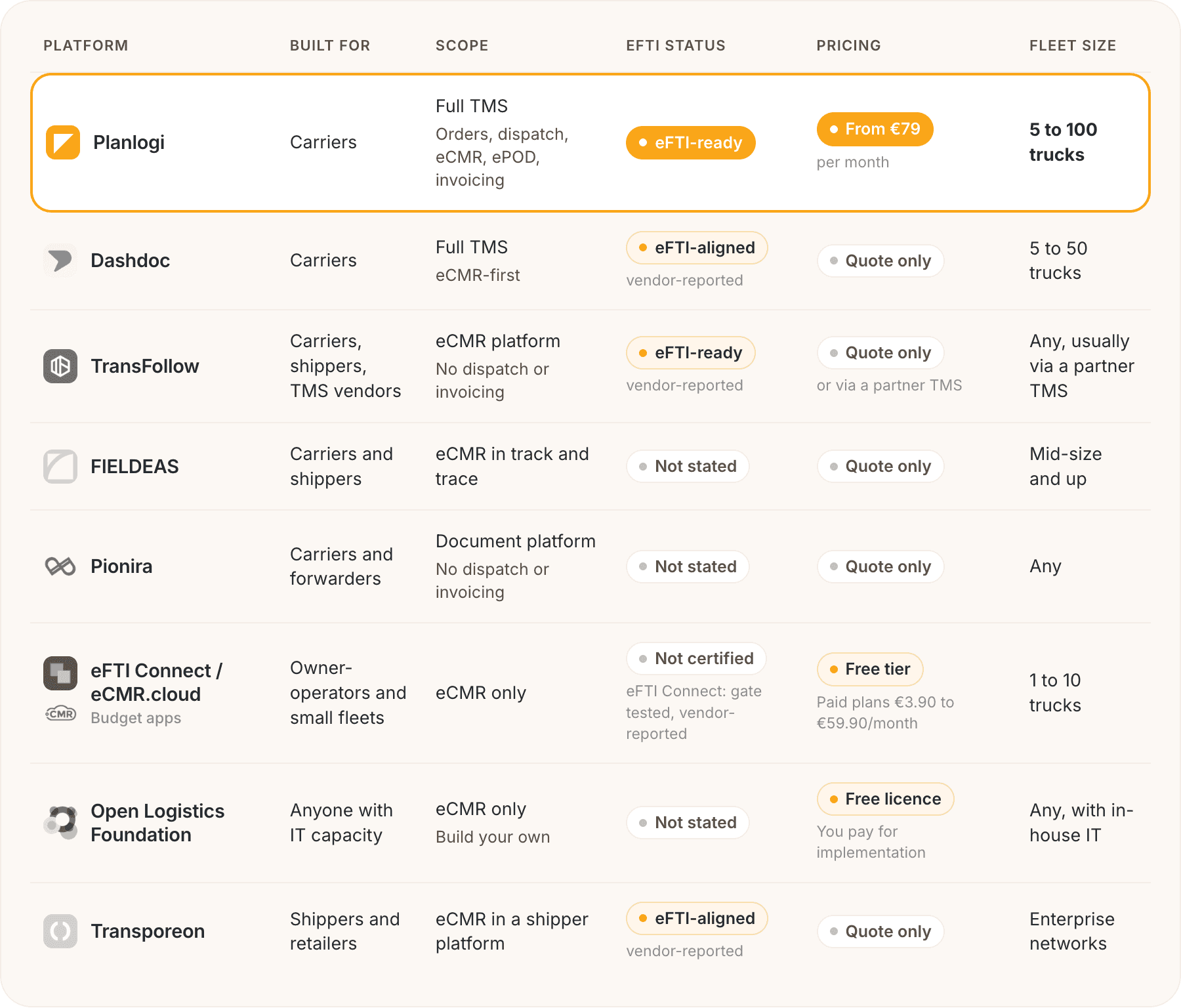
Planlogi and Dashdoc are full TMSs with eCMR built in. TransFollow, FIELDEAS, Pionira and Transporeon are eCMR platforms without published prices. eFTI Connect and eCMR.cloud are low-cost standalone apps with published prices, and the Open Logistics Foundation eCMR is free open-source software. No platform is eFTI-certified yet.
Prices and statuses are as published by each vendor in October 2026 and can change. “Vendor-reported” means we took the vendor’s word for it and could not verify it independently.
How we evaluated these eCMR tools
We scored each platform on seven criteria, in the order a small carrier actually buys. Carrier-side fit comes first: the tool has to serve the people who own and run the trucks, not the shipper buying freight. Second, the legal validity of the consignment note itself and how far along the vendor is on eFTI. Third, the driver app, including whether a signature and photo can be captured where there is no signal. After that: does the signed CMR flow into the invoice or get typed in again, does the tool work across countries and languages, and does the vendor publish a price (most in this category hide it behind a sales call). Last, how long it takes to go live.
Our evidence comes from vendor websites and documentation read in October 2026, regulator and standards pages (the European Commission’s eFTI pages, UNECE, Spain’s official gazette the BOE, and the NIWO, the Dutch road transport licensing body), review platforms, and Planlogi’s own experience onboarding European carriers. Please note: the Planlogi team wrote this guide, and Planlogi is one of the tools listed.
First, check it is actually an eCMR
An eCMR is an electronic consignment note with the same legal standing as the paper CMR, which it gets from the 2008 Additional Protocol to the CMR Convention when the data, signatures and audit trail meet the Protocol’s requirements. A scanned or photographed paper CMR is not an eCMR. A PDF with a logo is not an eCMR either.
Three layers often get mixed up, so it helps to separate them.
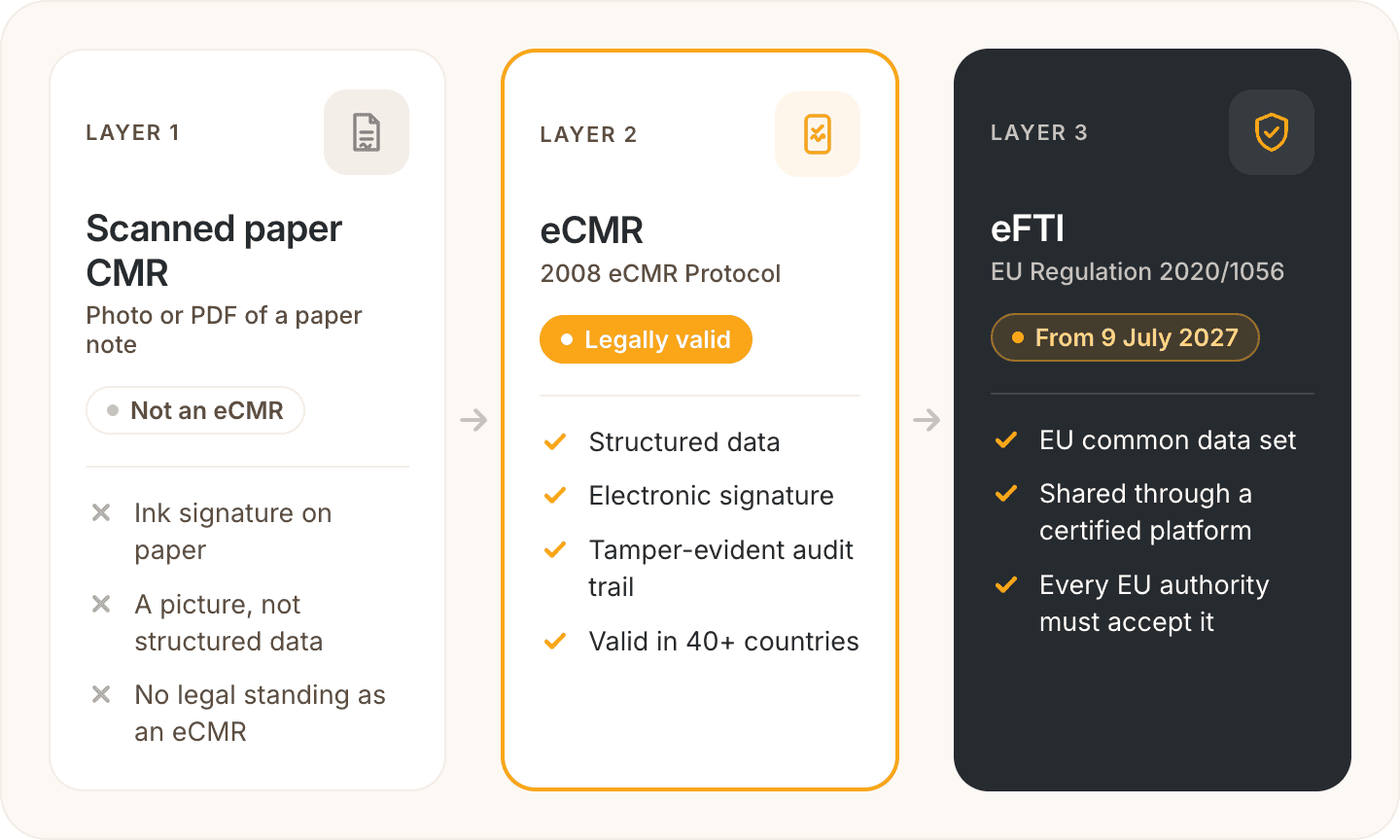
The first layer is a digitised paper process. The driver photographs the signed CMR, the office cleans up the picture and files it, the invoice goes out when the photo is legible. It saves some chasing. It has no standing as an electronic consignment note, and the signature on it is still ink.
The second layer is a legally valid eCMR. The consignment note is created as structured data, signed electronically at loading and unloading in a way that proves who signed, when and where, and stored with a tamper-evident log. Under the Protocol, that note is as good as paper in every country that has ratified it, which as of October 2026 is more than 40 countries, with Serbia joining on 2 November 2026 (UN treaty records via the Dutch treaty database, UN depositary notification).
The third layer is eFTI: making regulated freight information available to authorities as structured data through a certified platform under Regulation (EU) 2020/1056. From 9 July 2027, authorities across the EU must accept information presented this way. The platform requirements were set in Implementing Regulation (EU) 2025/2243 in November 2025. The certification rules were still pending in October 2026, and no platform anywhere was certified yet.
Spain is worth knowing about even if you never run there. Spain’s rule, in force since 5 October 2026, covers the domestic transport control document and requires it to be generated electronically and signed electronically. A printout alone does not comply. International runs stay under the CMR Convention, where the eCMR is valid but not compulsory. Spain shows that a national rule can run ahead of the EU timetable, and other countries can do the same.
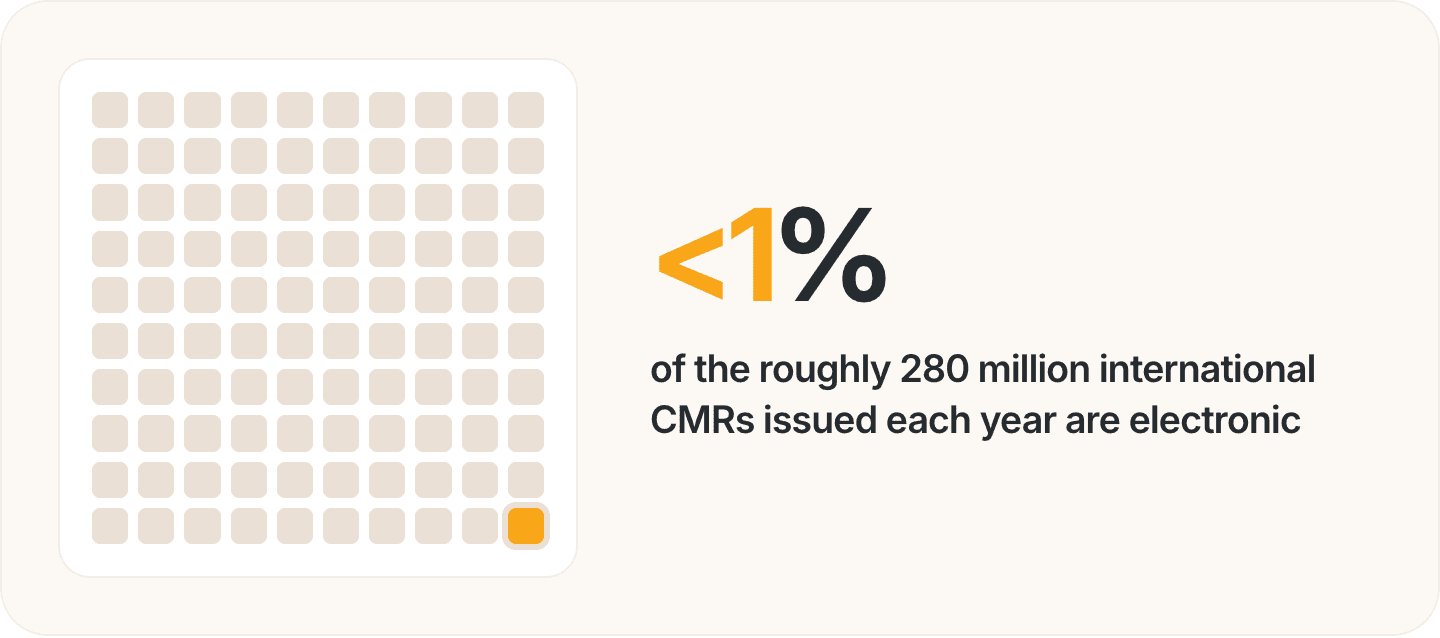
The IRU, the International Road Transport Union, estimates that fewer than 1 in 100 of the roughly 280 million international CMRs issued each year is electronic (as reported by trans.info). Most of your competitors are still on paper.
For the longer explanation of the Protocol and eFTI, read our eCMR and eFTI 2027 guide. For the questions to put to any vendor, read 10 questions to ask when choosing eCMR software.
1. Planlogi: best all-in-one eCMR for European carriers with 5 to 100 trucks
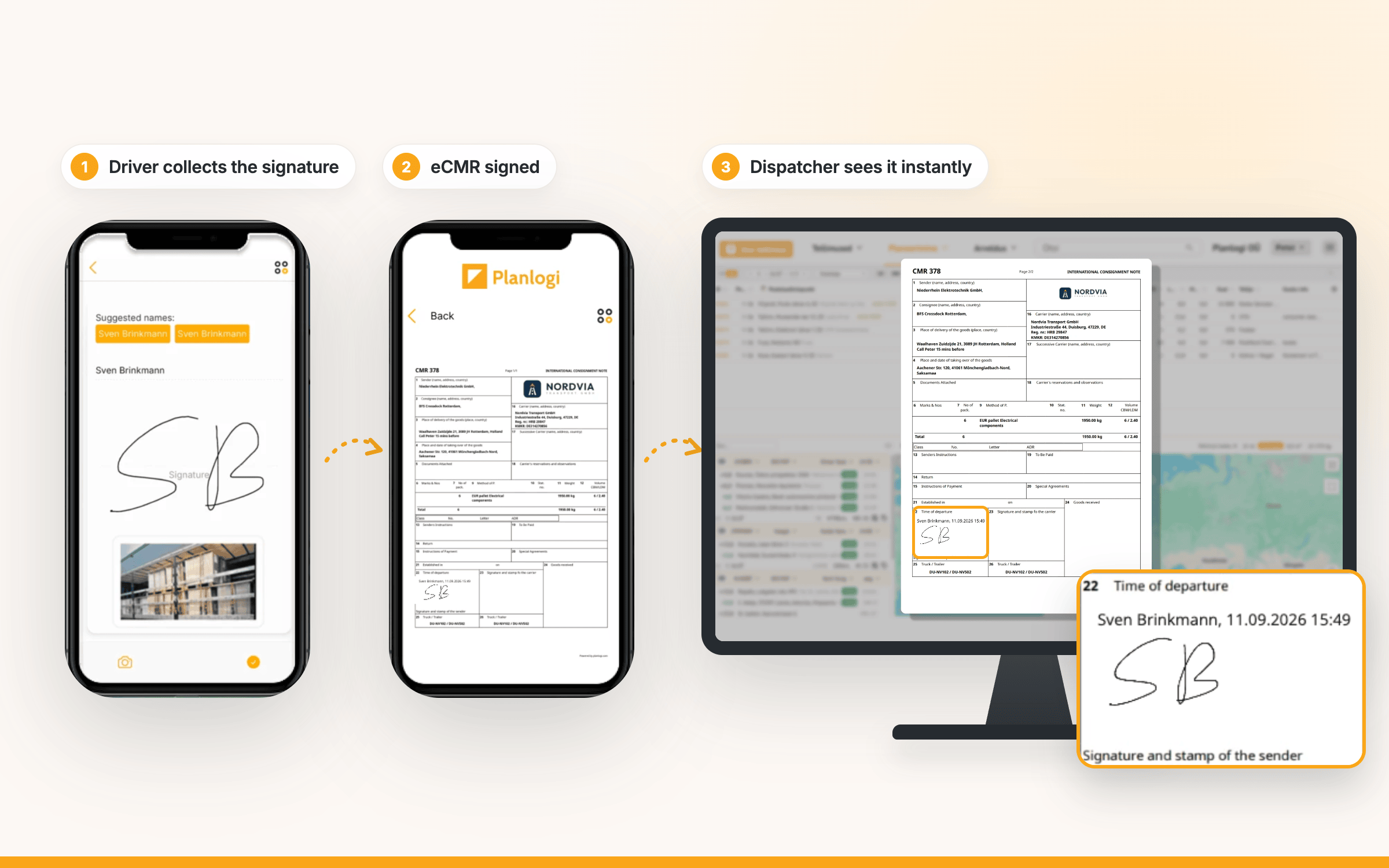
Planlogi is a cloud transport management system for European road hauliers running 5 to 100 trucks. The eCMR is part of the normal order flow: when a dispatcher enters an order, the parties, addresses, goods, weights and times become a draft consignment note. Planlogi checks the mandatory fields before the note is issued, so a driver is never handed a half-finished CMR. At loading and unloading the consignee signs in the driver app, and the signature, time and GPS point are pinned to the note. The signed eCMR drops into a searchable archive and is attached to the invoice.
Best for: carriers with 5 to 100 trucks who want the consignment note, the proof of delivery and the invoice to be one flow, and who want to be running it this week rather than this quarter. Strong fit for European carriers doing cross-border work into Germany, the Nordics and other EU corridors.
eCMR and eFTI status: on the official e-CMR integration list since 2024, and eFTI-ready under Regulation (EU) 2020/1056. Carriers have used Planlogi’s eCMR for over a year, and authorities across Europe have checked and accepted it without issues.
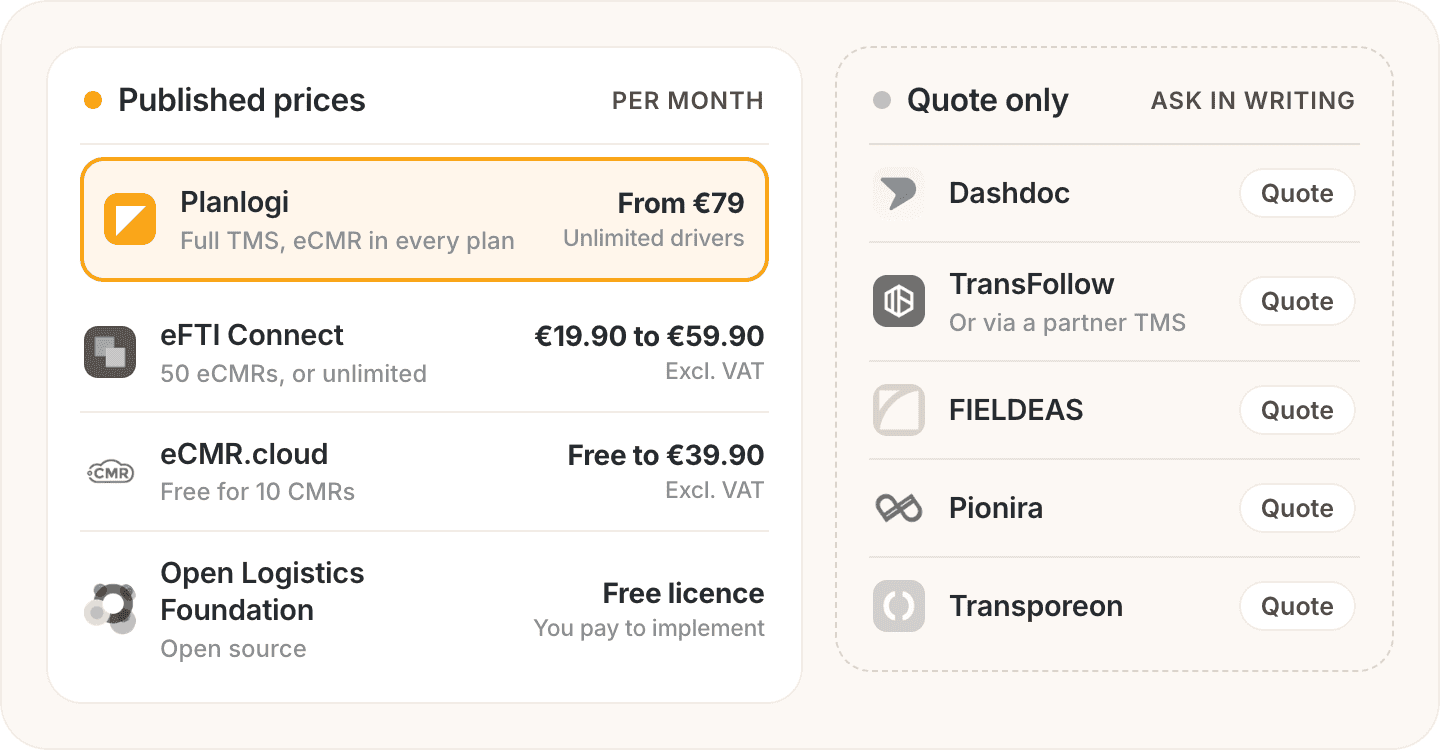
Pricing: plans start at €79 a month (Go, up to 50 orders a month), with Team at €199 and Pro at €499. eCMR creation and digital signing are included in every plan, drivers, vehicles and clients are unlimited, and there is no setup fee. Full pricing.
Strengths
No second data entry. The eCMR is built from the order, and the signed note feeds the invoice. Sivitrans, a car transporter with 15 vehicles, cut CMR creation from 9 minutes to 45 seconds and freed close to 500 hours a year.
Validation before issue. Missing fields, wrong combinations and the gaps a roadside check would catch are blocked before the note leaves the office. A subcontractor is carried onto the note automatically.
Drivers use it. At Olaret, a container haulier with 30 trucks, 80% of drivers actively use the system. New users are working in under an hour.

Where it falls short for a small European carrier
Planlogi is a TMS, but you do not have to use all of it. Many carriers run it for orders, the driver app and the eCMR and keep their current invoicing. If you want nothing about your dispatch to change, a lighter tool further down this list will do.
Not for you if: you run 500 or more trucks with custom integrations, you need a warehouse management system, you are a shipper rather than a carrier, or you want nothing to change except the paper.
Bottom line: Planlogi is the right eCMR for a European carrier with 5 to 100 trucks that wants the note, the POD and the invoice to be one job, at a published price, live in days.
2. Dashdoc: best eCMR-first TMS for French and Belgian carriers
Dashdoc started as an eCMR tool and grew into a transport management system, which shows in how polished the consignment-note workflow is. It uses its own signature engine rather than reselling someone else’s, and its signatures meet the advanced-signature level under eIDAS, the EU regulation on electronic identification and trust services (vendor-reported). Dashdoc says its eCMR is approved in 39 countries and that the app has a functional offline mode (vendor-reported). It is listed, as Dashdoc (formerly Truckfly), among the recognised e-CMR suppliers for Belgium on the NIWO’s Benelux list.
Best for: carriers with 5 to 50 trucks in France, Belgium and the Netherlands who want the best-known eCMR brand in the French market with a full TMS around it.
eCMR and eFTI status, October 2026: legally valid eCMR under the Protocol with eIDAS advanced signatures (vendor). Positioned as eFTI-aligned; no certification, as for everyone.
Pricing: quote only. Dashdoc does not publish prices.
Strengths
Own eIDAS advanced signature, not a TransFollow licence underneath.
Driver app with offline mode and a mature document workflow.
Where it falls short for a small European carrier
No published price, so you cannot budget without a sales call.
Buying Dashdoc means buying the whole TMS. If you are happy with your dispatch tool and only want eCMR, that is a bigger change than you asked for.
Bottom line: the eCMR-first TMS to shortlist if you are a French or Belgian carrier and want the document workflow to be the heart of the system. If you run trucks outside France and Belgium, our Dashdoc vs Planlogi comparison goes through eCMR, eFTI, the driver app and pricing point by point.
3. TransFollow: the eCMR rails most European TMSs run on
TransFollow is the Dutch eCMR platform that many other software vendors build on. In 2026 alone, Qargo (10 February) and Alpega (26 May) announced TransFollow integrations, and Spanish TMS Meribia runs it as well. TransFollow is a recognised eCMR provider in the Benelux, confirmed by the Dutch NIWO with recognition extended to 8 July 2027, and it is a member of the eCMR interoperability expert group the IRU set up in June 2026 with FIELDEAS, Pionira, IN Groupe and FIATA. You can use it directly through its portal and the TransFollow Drive app. Its Messenger option lets subcontracted drivers take orders and sign through WhatsApp, Telegram or Viber with nothing to install, while full eCMR management stays in the Drive app (vendor-reported).
Best for: carriers whose shippers or TMS already use TransFollow, and carriers in the Benelux who want the platform their counterparties are most likely to recognise.
eCMR and eFTI status, October 2026: recognised in the Benelux; positioned as eFTI-ready; not certified.
Pricing: not published. Most carriers buy it inside a partner TMS, so the price and the support come from the partner.
Strengths
Wide partner network in Europe.
Lightweight ways to sign without installing an app.
Where it falls short for a small European carrier
It is an eCMR platform, not a TMS. Dispatch, planning and invoicing live elsewhere.
Because you usually buy it through a partner, the small-carrier experience depends on which partner.
Bottom line: if your biggest customer says “we use TransFollow”, this is the answer. If you are choosing freely, it is one component, not the whole system.
4. FIELDEAS: best for Spanish carriers under the October 2026 rule
FIELDEAS is a Madrid-based platform whose eCMR module sits inside its Track & Trace product. It signs with an advanced electronic signature and timestamp (vendor-reported), it co-authored the Spanish Logistics Centre’s study on eCMR adoption in Spain, and it sits in the IRU’s interoperability group alongside TransFollow and Pionira. With Spain’s electronic transport control document mandatory since 5 October 2026, FIELDEAS is the Spanish specialist on the shortlist.
Best for: Spanish carriers and carriers running regularly into Spain who want a provider built around the Spanish rules and what Spanish inspectors expect.
eCMR and eFTI status, October 2026: advanced signature with timestamp (vendor); eFTI status not stated.
Pricing: not published.
Strengths
Built around the Spanish market and the Spanish mandate.
Advanced signature with timestamp and a track-and-trace layer around the document.
Interoperability work with the other European eCMR providers.
Where it falls short for a small European carrier
Enterprise-leaning, with project-style pricing you have to ask for.
Spain-centred, so it may suit carriers elsewhere in Europe less well.
Bottom line: built for Spain. Shortlist it if Spain is where your trucks are.
5. Pionira: best Benelux eCMR specialist
Pionira is a Belgian eCMR and e-document provider whose eWastra app handles mobile signing, timestamps, geolocation and archiving (vendor-reported). It is a recognised e-CMR supplier for Belgium on the NIWO’s Benelux list, it is part of the IRU interoperability group, and it partnered with Leviahub in 2026 to bring eCMR into Italy. Viewing and signing documents are free; creating them is paid (vendor-reported).
Best for: Belgian and Dutch carriers and forwarders who handle more than one kind of transport document and want a specialist with Benelux recognition.
eCMR and eFTI status, October 2026: NIWO-recognised; eFTI status not stated.
Pricing: quote only.
Strengths
Benelux recognition and a model where counterparties can sign without paying.
More than the CMR: other transport documents in the same app.
A small, specialised team that is close to the Belgian market.
Where it falls short for a small European carrier
It is a document platform. Dispatch and invoicing are not part of it.
Bottom line: a credible Benelux specialist, especially if Belgium is on your routes and you want more than the CMR digitised.
6. eFTI Connect and eCMR.cloud: best budget standalone eCMR apps
Two tools share this entry because they answer the same question: what is the cheapest way to replace paper CMRs for a fleet of ten trucks without buying a TMS?
eFTI Connect publishes two plans: Basic at €19.90 a month for up to 50 eCMRs and Standard at €59.90 a month for unlimited eCMRs, both excluding VAT and both with the driver app, electronic signing, document sharing and archiving (pricing page, October 2026). Extra documents on Basic cost €9.90 per ten. Its eCMRs can be exchanged with other platforms built on the Open Logistics Foundation model. On 30 September 2026 the company announced that it had tested eFTI gate integration against the eFTI4EU reference implementation and said in the same announcement that it is not yet eFTI-certified. We count that plain statement in its favour.
eCMR.cloud is a web-based tool for creating, managing and sending CMR documents. Its Free plan allows 10 CMRs a month for one user; Mini is €3.90 for 30, Basic €9.90 for 100, and PRO €39.90 for unlimited CMRs, all per month and excluding VAT (pricing page, October 2026).
Best for: owner-operators and fleets of 1 to 10 trucks whose dispatch and invoicing already work and who only want the consignment note off paper.
eCMR and eFTI status, October 2026: verify legal validity and signature level for your countries before relying on either. eFTI Connect: eFTI-ready by its own account, not certified.
Pricing: published, which is rare in this category. Price by monthly CMR volume, not by truck. Ten trucks doing four consignments a day produce close to 900 notes a month, which puts you well past a 50-document tier.
Strengths
Published prices you can compare in five minutes.
Low commitment and a short learning curve.
eFTI Connect states its certification status plainly and can exchange eCMRs with other OLF-based platforms.
Where it falls short for a small European carrier
Document tools only. Nothing flows to dispatch or the invoice, so the office still types.
Check the signature level, country coverage and what happens when a consignee refuses to sign on a phone.
Bottom line: the cheapest honest way to get the CMR off paper. Budget by document volume, and expect to outgrow it if the rest of the office is still on Excel.
7. Open Logistics Foundation eCMR: best free, open-source option if you have IT capacity
The Open Logistics Foundation’s eCMR is open-source software for electronic consignment notes, developed with 28 companies and shown at transport logistic 2025 in Munich. Markant leads the project, Rhenus and Dachser tested it on live routes, and Fraunhofer IML is part of the group. It uses a standardised data model and electronic seals, and it is designed to work without a central intermediary.
Best for: carriers and forwarders with in-house IT or a software partner who want zero licence cost and no vendor lock-in, and who are willing to implement and host it themselves.
eCMR and eFTI status, October 2026: built to be compliant with the CMR Convention (foundation); eFTI status not stated on the project page.
Pricing: free to use (trans.info). Implementation, hosting and maintenance are yours to pay for.
Strengths
No licence fee and full control of the data.
Backing from large logistics groups, so the data model is likely to be accepted widely.
Interoperable by design.
Where it falls short for a small European carrier
You are the integrator. A 10-truck haulier without a developer will not get this live.
No TMS around it, no support desk, and a roadmap driven by large enterprises.
Bottom line: the right choice for a well-resourced operator who wants to own the stack. Not a Monday-morning fix for a small office.
8. Transporeon eCMR: best inside large shipper and retailer networks
Transporeon, part of Trimble, offers eCMR as part of its platform for shippers and retailers. Signatures are eIDAS-compliant, the platform is ISO 27001 certified, and inspectors can access documents by QR code (vendor-reported). Carriers use it because their customer does.
Best for: carriers whose large shippers or retail customers run on Transporeon and who need to sign and exchange eCMRs inside that network.
eCMR and eFTI status, October 2026: eIDAS signatures (vendor); positioned for the EU’s digital freight documentation rules.
Pricing: quote only, and enterprise-scale (Capterra).
Strengths
The network your big customers may already be on.
Enterprise security and signature standards.
Documents and dock scheduling in one place for the shipper.
Where it falls short for a small European carrier
Built for the shipper. A small carrier is a participant in someone else’s platform, not the customer.
Enterprise scope and pricing. It does not run your dispatch or your invoicing.
Bottom line: join it when a customer requires it. Do not buy it as your own carrier-side eCMR.
Best eCMR software by situation
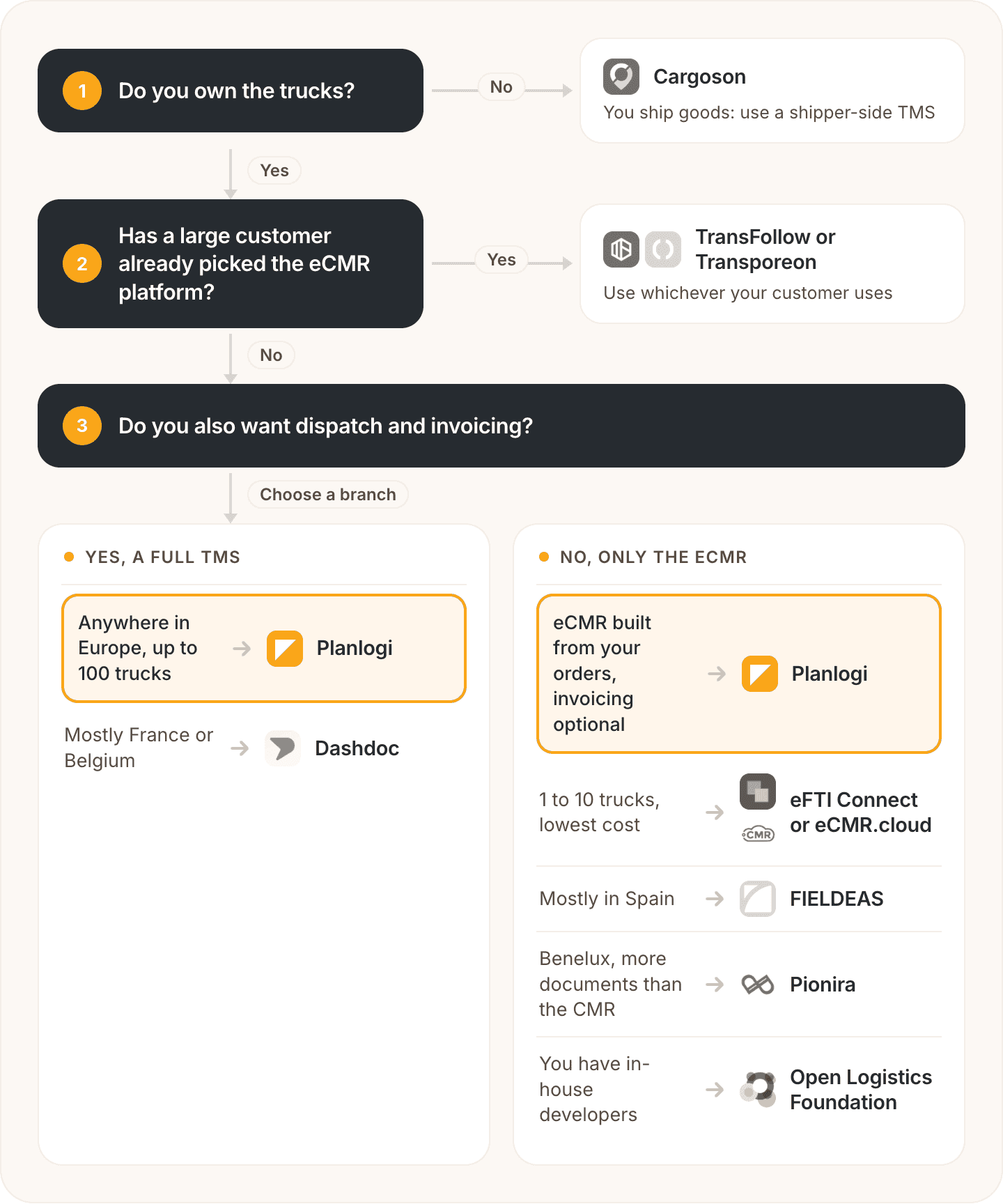
Best all-in-one for European carriers with 5 to 100 trucks: Planlogi.
Best eCMR-first TMS for France and Belgium: Dashdoc (how it compares with Planlogi).
Best for Spain’s domestic rule, in force since 5 October 2026: FIELDEAS, or a TMS that embeds TransFollow.
Best if your shipper already picked the platform: TransFollow or Transporeon, whichever they use.
Best Benelux specialist for more than the CMR: Pionira.
Best budget app for 1 to 10 trucks: eFTI Connect or eCMR.cloud.
Best free, if you have developers: Open Logistics Foundation eCMR.
Best for owner-operators who also want dispatch and invoicing: Planlogi Go at €79 a month.
If you are actually a shipper, not a carrier: Cargoson, below.
Tools people mistake for eCMR software
A few products turn up in every search for eCMR software and are not what a carrier needs. CMR form generators such as cmrsoftware.com, CMR Management and PrintCMR produce a correctly laid-out CMR for printing. Some are free for a handful of documents a month. They are useful for printing. They do not produce an eCMR. Freight exchanges such as TIMOCOM and Trans.eu are load boards with some document features, not consignment-note platforms. Real-time visibility platforms such as Shippeo and Sixfold are shipper tools for tracking, and where they offer eCMR it is for the shipper’s benefit. EDI connectors such as EDITEL’s FreightLogs move document data between systems and have no driver app.
Then there is Cargoson, an Estonian shipper-side TMS with a published price of €199 a month. It lets carriers sign eCMRs for free inside the shipper’s account, which is why it appears next to Planlogi in Estonian searches. If you ship goods, it is a good tool. If you own the trucks and want your own consignment notes, archive and invoice flow, you need a carrier-side platform.
You will also see Qargo, Alpega, Akanea, Sinari and Meribia offering eCMR. All of them run TransFollow underneath, so the TransFollow entry above tells you what you are getting. And a longer tail of apps exists: DeCMR, Cargoledger, Collect & Go, TransLedger in Spain, GetCMR, Ybil, Meight, CargoMind and Transportial’s free browser-based eCMR. We have not evaluated them to the same depth and do not rank them.
The five fears every eCMR vendor has to answer
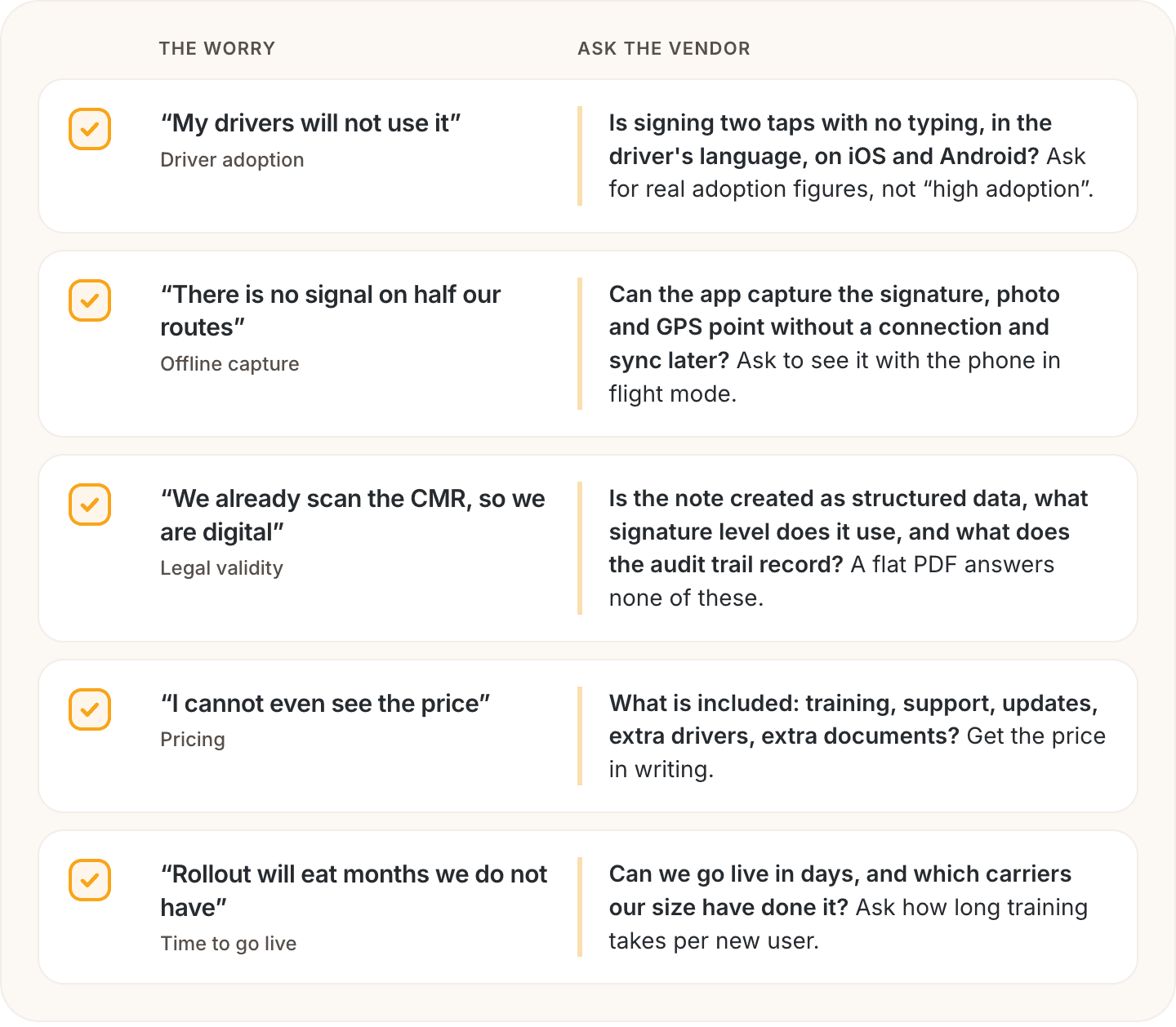
Carriers who stay on paper usually have one of five worries. Each is reasonable, and each turns into a question you can put to any vendor on this list.
“My drivers will not use it.” Drivers are paid to drive, and an app that adds admin will be ignored. Ask for two-tap signing with no typing, a user interface in the driver’s language, and both iOS and Android. Ask for real adoption figures. Olaret’s 80% of drivers actively using Planlogi is the kind of number to look for; “high adoption” is not.
“There is no signal on half our routes.” Loading bays, ports and border car parks are dead zones. Ask whether the app captures the signature, a photo and the GPS point without a connection and syncs later, and ask to see it done with the phone in flight mode.
“We already scan the CMR, so we are digital.” You are halfway. Ask the vendor whether the note is created as structured data, what signature level it uses, and what the audit trail records. A flat PDF export is not the answer to any of those questions.
“I cannot even see the price.” Quote-only pricing tells you something about the relationship ahead. Ask what is included: training, support, updates, extra drivers, extra documents. Three tools on this list publish their prices and one is free; the others should be able to give you a price in writing.
“Rollout will eat months we do not have.” With Spain already live and July 2027 fixed, a six-month rollout spends your whole runway. Ask for go-live in days and for the names of carriers your size who did it. Planlogi’s own figure is under an hour of training for a new user; ask every vendor for theirs.
What changes between now and July 2027
Two dates are fixed: Spain’s electronic transport control document has been mandatory since 5 October 2026, and from 9 July 2027 every EU authority must accept freight transport information electronically under the eFTI Regulation.
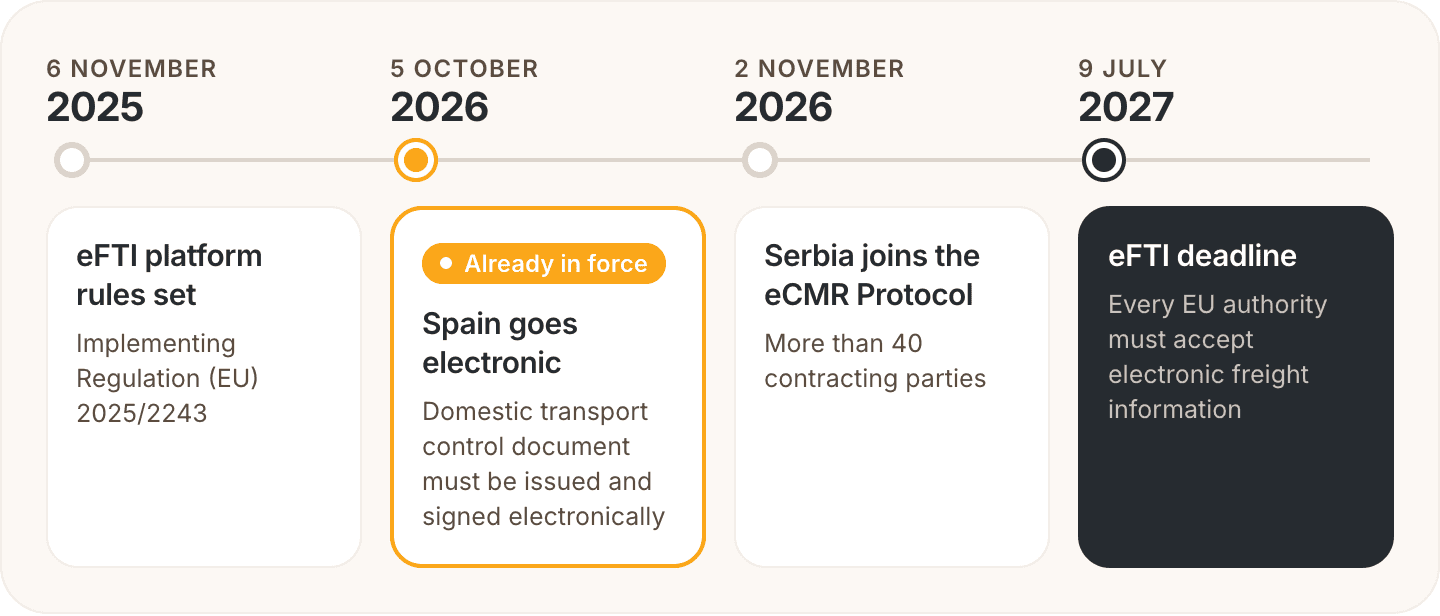
The 2027 obligation is on authorities to accept electronic information; carriers are not required to switch. Nobody will fine a haulier for carrying paper on 10 July 2027. But shippers are moving earlier, Spain has shown that national rules can run ahead of the EU, and the carrier who waits will be told by its largest customer which platform to log into.
Frequently asked questions
What is the best eCMR software for a small carrier in Europe?
For a carrier with 5 to 100 trucks that wants the consignment note, proof of delivery and invoice in one flow, Planlogi is the best fit, at a published price from €79 a month. For a French or Belgian carrier that wants an eCMR-first TMS, Dashdoc. For a fleet of 1 to 10 trucks that only wants the CMR off paper, eFTI Connect or eCMR.cloud. For a Spanish carrier, FIELDEAS. If your shipper already uses TransFollow or Transporeon, use what they use.
Is a signed PDF an eCMR?
No. A scan or PDF of a signed paper CMR has no standing as an electronic consignment note under the 2008 eCMR Protocol, and it does not meet Spain’s requirement for an electronically generated and electronically signed control document. An eCMR is structured data with an electronic signature and an audit trail.
Is eCMR mandatory in Spain?
Spain’s domestic transport control document has had to be electronic since 5 October 2026 under Ley 9/2025. For international transport under the CMR Convention, the eCMR is legally valid but not compulsory.
Do I need an eFTI-certified platform yet?
No, because none exists. The requirements for eFTI platforms were set in November 2025, the certification rules were still pending in October 2026, and no vendor on this list holds a certificate. Choose a legally valid eCMR from a vendor that is building to the eFTI data set and states its status plainly.
How much does eCMR software cost per truck?
Standalone eCMR apps run from a free tier of 10 documents a month, through €19.90 a month for 50, to €39.90 or €59.90 a month for unlimited documents. A carrier TMS with eCMR included starts at €79 a month for up to 50 orders with Planlogi. Dashdoc, TransFollow, FIELDEAS, Pionira and Transporeon do not publish prices. We have broken down how Dashdoc’s quote is built, with a worked example for a 20-truck haulier. Price by monthly CMR volume as well as by truck. All figures are as published in October 2026.
Is there free eCMR software?
Yes, with catches. The Open Logistics Foundation’s eCMR is free open-source software you implement yourself. eCMR.cloud has a free tier of 10 documents a month. CMR Management offers a free tier for printing a few CMRs, which gives you paper, not an eCMR.
Does eCMR work without a mobile signal?
It does when the app captures the signature, photo and location offline and syncs later. Dashdoc states a functional offline mode. Ask every vendor to demonstrate it with the phone in flight mode.
What is the difference between eCMR software and a TMS?
eCMR software creates, signs and stores electronic consignment notes. A transport management system runs orders, dispatch, the driver app, proof of delivery and invoicing, and may include eCMR as one part. TransFollow, Pionira, eFTI Connect and eCMR.cloud are eCMR tools. Planlogi and Dashdoc are TMSs with eCMR built in.
Which eCMR apps are accepted in Germany, the Netherlands and Estonia?
Any Protocol-compliant eCMR is legally valid in all three. The NIWO publishes the Benelux list of recognised suppliers, which includes TransFollow (Viaservice), Collect & Go, Cargoledger, Pionira and Dashdoc. Estonia’s Transport Administration keeps an integration list that includes Planlogi. Germany has no national list.
Country | How acceptance works | Where to check |
|---|---|---|
Netherlands (and Benelux) | The NIWO publishes the list of recognised e-CMR software suppliers for the Benelux pilot. Netherlands: Viaservice (TransFollow), Collect & Go, Disruptive Logistic Innovations, Cargoledger, Logistiek Zonder Papier. Belgium: Pionira, Dashdoc (formerly Truckfly). List updated 1 March 2024; TransFollow’s recognition runs to 8 July 2027 | |
Estonia | The Transport Administration (Transpordiamet) keeps an e-CMR integration list of systems connected to the national register. Planlogi has been on it since 2024 | Transpordiamet |
Germany | Ratified the Protocol; there is no national supplier list. A Protocol-compliant eCMR is accepted at roadside checks. TruckMovers’ Planlogi eCMR was checked and accepted by German police | Federal Ministry for Digital and Transport |
Is a signed delivery note or packing list a valid proof of delivery, and is it a CMR?
A signed delivery note proves the goods were handed over, which is usually enough to invoice. It is not a consignment note. The CMR is the contract of carriage document, and under the CMR Convention it is the document that carries reservations about shortages or damage. An eCMR gives you both in one record.
How does an eCMR help with a damage or shortage claim?
Under Article 30 of the CMR Convention, apparent loss or damage must be reserved at delivery, non-apparent loss or damage within seven days in writing, and delay within 21 days. Taking delivery without a reservation is prima facie evidence that the goods arrived as described. An eCMR records the reservation, the photo, the time and the place on the note itself, on both parties’ copies, at the moment it happens.
Choosing your eCMR software
Pick the tool that is built for the carrier’s side of the desk, produces a legally valid eCMR, works in the driver’s hand with or without signal, and gets the signed note into the invoice without anyone typing it again. Then check the vendor’s eFTI statement for a date and a plain answer.
If you want to see how Planlogi handles the eCMR inside the whole dispatch-to-invoice flow, take the product tour or book a 20-minute demo. If one of the other seven is the better fit for your fleet, we would rather you knew that now.