
eCMR is the electronic version of the international consignment note that has accompanied every cross-border road shipment in Europe since the 1956 CMR Convention.
From 9 July 2027, every authority across the European Union will be obliged to accept freight transport information submitted electronically through a certified eFTI platform under Regulation (EU) 2020/1056. After that date, roadside inspectors, customs officers, port authorities and labour inspectorates cannot demand a paper original when the digital record is available and compliant.
For European hauliers, this is the first material change to road freight documentation in seventy years.
The carriers who treat the deadline as a starting line will spend 2026 and early 2027 helping their customers transition. The carriers who wait will be told by their customers which platform to use.
This guide explains what the eCMR is, what the eFTI Regulation actually requires, what your fleet must do before the deadline, and how to evaluate the platforms that will carry your data. If you only have ten minutes, the 14-point readiness checklist further down will tell you exactly where you stand.
From CMR to eCMR: what actually changes
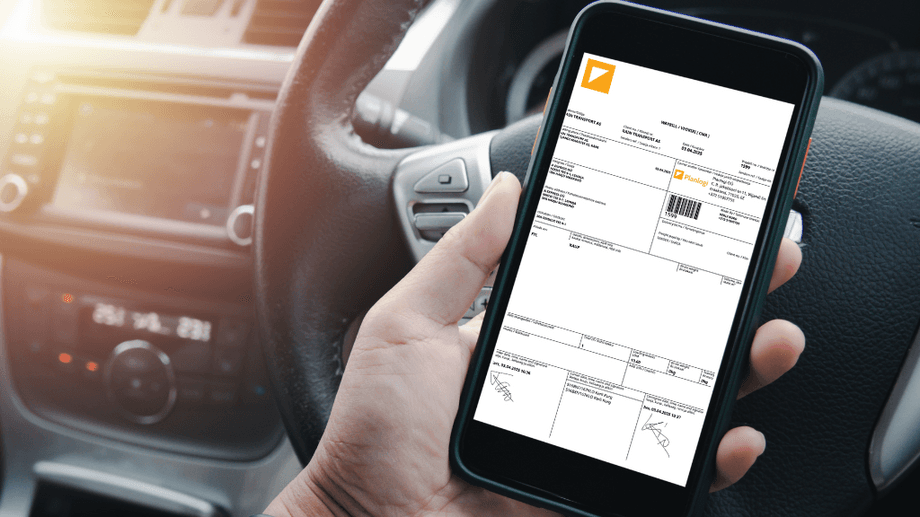
The CMR consignment note has been the backbone of international road freight in Europe since the Convention on the Contract for the International Carriage of Goods by Road (CMR) was signed in Geneva in 1956. Every cross-border road shipment in Europe has been accompanied by one ever since. The document does three jobs at once.
It is the contract of carriage between the sender and the carrier.
It is the proof of delivery used to release payment.
And it is a recognised customs document.
The eCMR is the electronic version of that same document. Its legal basis is the eCMR Additional Protocol of 2008, administered by UNECE, which gives a digital consignment note exactly the same legal weight as the paper version, provided that the data is captured, signed and exchanged in a way that guarantees authenticity, integrity and non-repudiation.
Thirty-six countries have now ratified the protocol, including all major European freight markets such as France, Germany, the Netherlands, Spain, Poland, Italy, the Nordics, Estonia, and the United Kingdom.
For fleet dispatchers and drivers, the practical changes show up in five places.
The first is signing. Instead of pen and paper, the consignee signs on glass with a finger or stylus, or confirms receipt with a one-time code.
The second is transmission. The signed document is in the carrier’s office and the consignee’s accounting inbox within seconds, not the following Tuesday.
The third is what gets captured automatically: GPS coordinates, timestamps, photographs of the goods, and a tamper-evident audit trail are all attached to the record without anyone having to remember.
The fourth is the end of the missing-cab-copy problem.
The fifth, and the one that owner operators usually feel first in the bank account, is invoicing. When the proof of delivery (POD) exists in clean digital form (ePOD) the moment the wheels stop rolling, the invoice can be raised and sent within minutes.
The EU eFTI Regulation: the deadline that makes eCMR non-optional
The eCMR Protocol made digital consignment notes legally possible. The eFTI Regulation, formally Regulation (EU) 2020/1056, is what makes them practically unavoidable.
eFTI stands for electronic Freight Transport Information. The Regulation was adopted on 15 July 2020 and applies to information that operators are required to share with competent authorities under a defined list of EU legal acts, covering road, rail, inland waterway and air freight. It does two things. First, it obliges every Member State authority that has a regulatory reason to inspect freight transport data to accept that data electronically when it is provided through a certified eFTI platform. Second, it defines the technical, governance and certification framework that those platforms must meet.
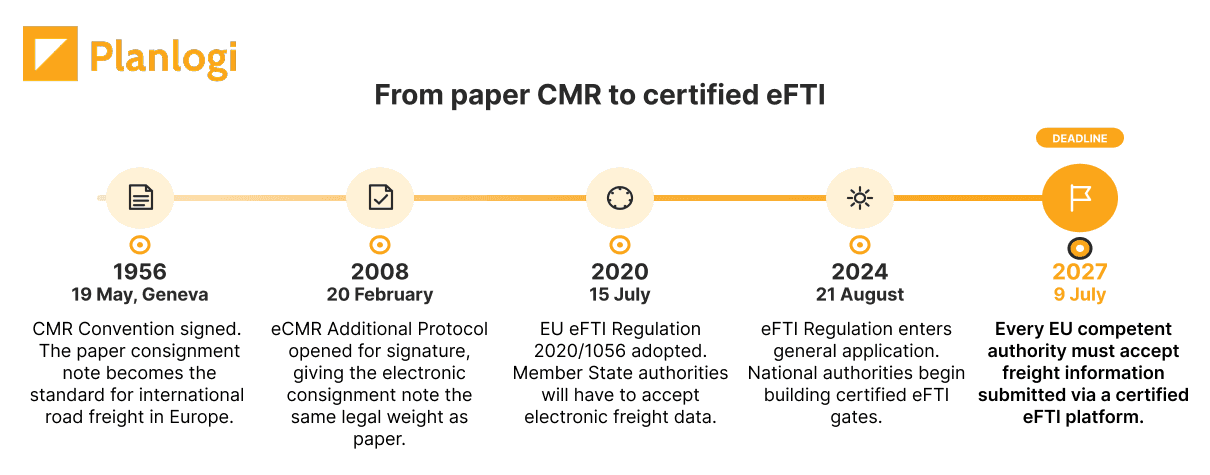
There are two dates to note and keep in your calendar.
21 August 2024 is when the Regulation entered into general application. From this date, the legal framework is live and Member States have been preparing their national IT systems and certifying competent authorities (European Commission update, January 2025).
9 July 2027 is the date that matters for operators. From this date, every competent authority across the EU is obliged to accept eFTI shared electronically through a certified platform. After this date, an inspector at a roadside check, a customs officer at a port, or a labour inspectorate auditing your driver hours can no longer demand the paper original when the digital record is available and compliant. They have to accept it.
The European Commission adopted the first eFTI Implementing Act and the first two Delegated Acts on 5, 15 and 26 July 2024 respectively, covering procedures for competent authorities, the scope of national provisions, and the eFTI common data set (CLECAT briefing; eFTI4EU news).
The Implementing Act for government IT systems followed on 20 December 2024. Each Member State has been designated a competent authority and is now in the process of building or procuring the national eFTI gate that will receive operator data. Carriers should expect to see formal communication from their national authority through 2026.
What an eCMR actually contains: the data behind the document
eCMR is not a PDF. This is the single point most often missed by hauliers who think they are already compliant because their drivers email a signed scan from the cab.
The eFTI common data set defines exactly which data fields must be captured, in which structure, and in which machine-readable format. The dataset mirrors the data fields of a paper CMR (consignor, consignee, place of taking over, place of delivery, dates, goods description, packaging, weight, charges, dangerous goods information under ADR, special instructions and so on) but adds the fields that only a digital record can carry: precise timestamps, geolocation, signature blocks compliant with eIDAS, transmission logs, and a unique eFTI identifier.
The eIDAS Regulation (EU) 910/2014 defines three levels of electronic signature: simple, advanced, and qualified. To give an eCMR the same evidential weight in court as a paper CMR, most legal commentators recommend at least an Advanced Electronic Signature, with Qualified Electronic Signatures used where the highest evidential standard is needed. A photograph of a fingerprint or a typed name is not enough.
Practically, this means three things. Your platform must support eIDAS-compliant signatures. The data must be exported and exchanged in the eFTI schema, not in a free-form PDF. And the audit trail (who signed, where, when, what changed, who accessed) must be retained and produceable for the duration required by national rules.
The takeaway is: a digitised paper workflow is not the same as an eCMR, and an eCMR is not the same as eFTI compliance. The first is a habit improvement. The second is a legal document. The third is a regulated, certified data exchange. By July 2027, only the third counts.
Cross-border practical: what changes for European carriers
The corridors with the highest paper friction are also the ones that benefit first.

United Kingdom to European Union.
The United Kingdom ratified the eCMR Protocol in 2019. The UK is not directly bound by the eFTI Regulation, but UK hauliers running into the EU will be subject to the requirement that their data is presentable to EU authorities in eFTI-compliant form on entry. In practice, your platform needs to be able to produce eFTI-conformant output even if your home jurisdiction is the UK. Think of it the way the customs landscape changed at Calais and Dover in 2021: the requirement is on the goods movement, not on the carrier’s nationality.

Netherlands to Germany.
This is the most active eCMR pilot corridor in Europe. Both Inspectie Leefomgeving en Transport in the Netherlands and the Bundesamt für Logistik und Mobilität in Germany have been running cross-acceptance pilots since 2018. Carriers active here have a head start, and a number of large shippers in the corridor are already requiring eCMR support as a tender condition.

Estonia to Finland and the Baltic to Nordic corridors.
Short crossings, high frequency, low margin. Paper friction in this corridor swallows entire load economics. Both Estonia and Finland are early ratifiers of the eCMR Protocol. The Estonian state has a subsidy programme listing recognised eCMR vendors, which carriers in the region should investigate before procuring a platform.
Customs interaction. The eFTI common data set was deliberately designed to align with the data already required for customs processes such as the Import Control System 2 (ICS2). Operators with a clean eFTI workflow will find that their customs declarations become easier, not harder, because the source data is already structured and signed.
Choosing an eCMR platform: carrier-side TMS versus shipper-side eCMR
Most published guidance on eCMR is written for shippers. The economics are different for carriers, and so is the choice.
A shipper-side eCMR offering, often bundled into a freight procurement platform, is typically free or low cost for the shipper because the shipper’s value lies in vendor management and tendering, not in the document itself.
For the carrier, accepting that platform usually means accepting the shipper’s pricing, the shipper’s data governance, and a workflow built around the shipper’s office, not around the cab. Multiply this across ten or fifteen customers and the carrier ends up running ten or fifteen logins, none of which speak to each other.
A carrier-side TMS treats the eCMR as one output of a planning, dispatch and invoicing workflow that already exists. The same platform that schedules the load, instructs the driver, captures the proof of delivery, integrates with the accounting system, and bills the customer is the platform that produces the eCMR and the eFTI-compliant data set. Data stays under the carrier’s control. The driver opens one app. The dispatcher works in one screen. Invoicing is the same workflow whether the customer is a one-off freight buyer or a ten-year contract.
The seven questions every carrier should ask any vendor before signing:
Are you on a recognised path to eFTI certification with at least one EU competent authority?
Do you support the full eFTI Annex I common data set, or only a subset?
Do you offer eIDAS-compliant electronic signatures, and at which level (Advanced or Qualified)?
What is your interoperability story for cross-border operators sending eFTI to multiple national gates?
What happens to my data if I leave? Do I get a clean export in the eFTI schema?
Does the driver app work on both iOS and Android?
What is the pricing model: per truck, per shipment, per dispatcher, per signed document?
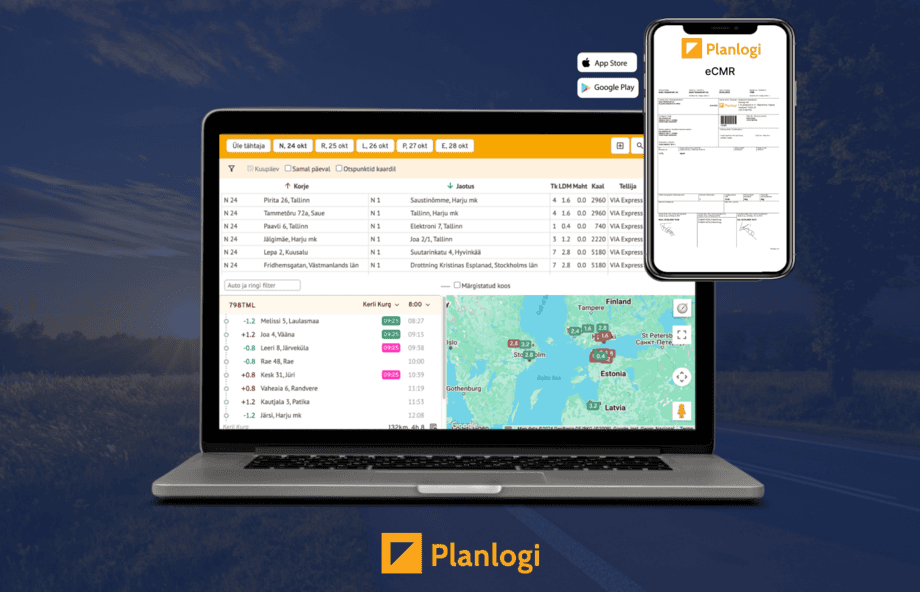
Planlogi is a carrier-side EFTI-compliant TMS built specifically for European hauliers in the 5-100 truck range.
Our eCMR module auto-generates eCMRs, supports eIDAS-compliant signatures and exports to the eFTI common data set. The platform is designed so that a dispatcher can plan a route, a driver can sign a delivery on a tablet, and the accounting integration can raise an invoice from the same record.
If you want to see how that looks in practice, you can book a thirty-minute walkthrough.
“Before Planlogi, it took us 9 minutes to compile a CMR. Now, with Planlogi, we get it done in 45 seconds.“
Patrick
Dispatcher at Sivitrans
Are you ready for eFTI? A 14-point readiness checklist
Run through these questions with your operations lead. If you answer yes to twelve or more, you are in good shape. Anything below ten is a planning prompt.
Data readiness
Can your current system export the full eFTI Annex I data set in machine-readable form, not as a PDF?
Are dangerous goods (ADR), temperature-controlled and oversized-load fields captured as structured data, not as free text in a notes box?
Are timestamps and GPS coordinates captured automatically at pickup, in transit and at delivery?
Is the audit trail tamper-evident and retrievable for the period required by your national authority?
Customer readiness
Have you confirmed in writing with your top five customers whether they will be sending or receiving under eFTI rules by Q3 2026?
Do you know which of your customers will require Advanced Electronic Signatures and which will accept simple ones?
Platform readiness
Is your TMS or document vendor on a recognised eFTI certification path with at least one EU competent authority?
Does your platform support eIDAS-compliant signatures, and at what level?
Do you have a clean data-export path if you ever need to leave the platform?
Driver readiness
Does your driver app work on both iOS and Android, and offline?
Have your drivers used the digital signature workflow at least ten times in live conditions?
Do you have a documented procedure for what happens when a customer still asks for a paper copy?
Audit readiness
Is your data retention period set to meet the longest national requirement on any of your routes?
If a roadside inspector asked you to produce the eFTI record for a delivery from six months ago in under five minutes, could you?
Why you should not wait until July 2027
The July 2027 eCMR deadline is not a cliff. It is a starting line. Carriers who are already running eFTI-conformant platforms by the middle of 2026 will spend the second half of 2026 and the first half of 2027 helping their customers transition. Carriers who wait will spend that period being told by their customers which platform they have to use.
McKinsey’s Digital Logistics survey of more than 260 shippers and logistics providers found that the operators pulling ahead in digital adoption are doing so by integrating planning, execution and document workflows in a single system, not by bolting on point solutions. Deloitte’s Future of Freight makes a similar point about the cost of delay: the cheapest moment to integrate a new compliance requirement is before it is enforced, not after.
Three things every European haulier can do this quarter:
Map your current document flow on a single page. Where does information enter, who handles it, and where does the proof of delivery end up?
Ask your top five customers whether they will be sending or receiving under eFTI rules by Q3 2026, and what platform they expect you to use.
Shortlist two or three carrier-side TMS platforms before your largest shipper chooses for you.
If you would like to see how Planlogi handles eCMR and eFTI compliance for hauliers running 5-100 trucks, you can book a thirty-minute walkthrough.
Frequently asked questions
What does eCMR mean for a small haulier with 5 to 20 trucks?
The eCMR is the electronic version of the international consignment note that has accompanied every cross border road shipment in Europe since the 1956 CMR Convention. For a small haulier, it replaces the paper carbon copies that get lost in the cab, the chasing of signed proofs of delivery, and the two week wait to invoice. The dispatcher plans the load and the driver signs on a tablet at delivery, with the signed record reaching the office and the customer’s accounting inbox within seconds. Planlogi is a carrier side TMS built for hauliers in the 5 to 100 truck range, with eCMR included as part of the planning, dispatch and invoicing workflow.
What is the eFTI 2027 deadline and what happens if my fleet is not ready?
From 9 July 2027, every Member State competent authority across the European Union must accept freight transport information shared electronically through a certified eFTI platform under Regulation (EU) 2020/1056. After that date, roadside inspectors, customs officers, port authorities and labour inspectorates cannot demand a paper original when the digital record is available and compliant. Carriers without a certified platform will still operate, but their shippers will increasingly require eFTI conformant data, and the operational advantage will sit with carriers who moved first.
Is an eCMR the same as a PDF of a signed paper CMR?
No. A scanned PDF of a signature is not an eCMR. A compliant eCMR is a structured, machine readable record that meets the eFTI common data set requirements, includes a tamper evident audit trail, and uses electronic signatures recognised under the eIDAS Regulation (EU 910/2014). If your current process is to email a signed scan, you are not eFTI compliant, even if the workflow feels digital. A purpose built platform handles the schema, the signature and the audit trail by default so dispatchers and drivers never see a JSON file.
Will my drivers actually use an eCMR app, especially older drivers?
Driver adoption, not the technology, is the hardest part of any rollout. The platforms that succeed work on a tablet or phone the driver already uses, function offline, and require no more than two or three taps per delivery. Tarvi Transport, an Estonia to Finland line haulier whose drivers are mostly over 50, switched their entire signing workflow to a tablet app with Planlogi. Driver feedback was simply: very practical, why did we not have this before.
How quickly can a small or mid size haulier implement an eCMR platform?
A purpose built carrier side TMS with eCMR included can be implemented in days, not months. The slowest part is usually integrating accounting software and onboarding drivers. Planlogi is designed for sub one hour onboarding for a single dispatcher, with full fleet rollout typically completed within two to four weeks. Enterprise TMS platforms by contrast often take three to six months.
Why does it matter whether my eCMR platform is built for carriers or for shippers?
A shipper side eCMR is built around vendor tendering and is usually free for the shipper. The carrier accepts the shipper’s pricing, the shipper’s workflow and the shipper’s data governance. Across ten or fifteen customers, that becomes ten or fifteen logins that do not speak to each other. A carrier side TMS like Planlogi gives you one workflow for every customer, the data stays under your control, and the eCMR is part of the planning and invoicing system you already use.
How does eCMR actually speed up invoicing and cash flow?
The paper CMR is the document that releases payment. When the signed paper sits in a cab for two weeks before reaching the office, the invoice waits with it. Carriers moving to digital proof of delivery typically reduce their invoice cycle from days to minutes. Tarvi Transport reports saving four to five hours per week on invoicing alone after switching to Planlogi, with the invoice raised the moment the route status turns green.
Do I need an eCMR if I only run domestic transport?
Strictly, the CMR Convention covers international carriage, so the paper CMR has only applied to cross border movements. The eFTI Regulation covers a broader set of freight transport information requirements, and several Member States are aligning their domestic rules. Many large domestic shippers are also adopting digital documentation for operational reasons. Domestic only carriers should plan for an eFTI ready workflow over the next 12 to 24 months even if they are not legally required to today.
What happens at customs or a roadside check if my data is not eFTI compliant?
Until 9 July 2027, paper alternatives remain valid in most countries and authorities accept what they accept today. After 9 July 2027, if you cannot present eFTI conformant data through a certified platform, you will rely on paper, which will increasingly be a delay rather than a default. For regular cross border runs such as UK to EU, Netherlands to Germany or Estonia to Finland, being eFTI ready by mid 2026 means smoother customs interaction and aligned data with the Import Control System 2 (ICS2).
How much does an eCMR platform cost for a small haulier?
Costs vary. Public reference implementations of the document standard are free. Shipper side platforms are free for the shipper but lock the carrier into the shipper’s pricing. Carrier grade TMS platforms with eCMR included are typically priced per truck or per dispatcher, ranging from a few euros per truck per month at the low end to enterprise pricing at the top. Planlogi offers transparent flat monthly plans priced by order volume (Go €79, Team €199, Pro €499, Max from €1,200 per month) for hauliers in the 5 to 100 truck range, with the eCMR module included in every plan rather than billed separately.
Can I run paper and eCMR in parallel during the transition?
Yes. The eFTI Regulation does not ban paper. It obliges authorities to accept digital. Many carriers, including Tarvi Transport, run a hybrid model where the eCMR is the system of record and paper is printed only for the small number of customers who still ask. This lets you build operational confidence with the digital workflow while keeping legacy customers comfortable.
What happens to my data if I leave my eCMR platform?
This is one of the most important questions to ask any vendor before signing. A reputable carrier side TMS should offer a clean export of your eCMR records in the eFTI schema at no extra cost. Planlogi commits to standard format export on exit so your records remain yours regardless of where you operate them. Any vendor who answers this question vaguely is a vendor to walk away from.


