
A paper CMR and an eCMR are legally the same document: the consignment note that travels with every international road shipment in Europe. The difference is what they cost you.
Based on published per-document studies and our own customer data, running paper costs a fleet roughly €2,500 to €5,700 per truck per year in handling, chasing and delayed invoicing. An eCMR removes most of that.
Let’s dig deeper into the maths, line by line.
The stack of paper between you and your money
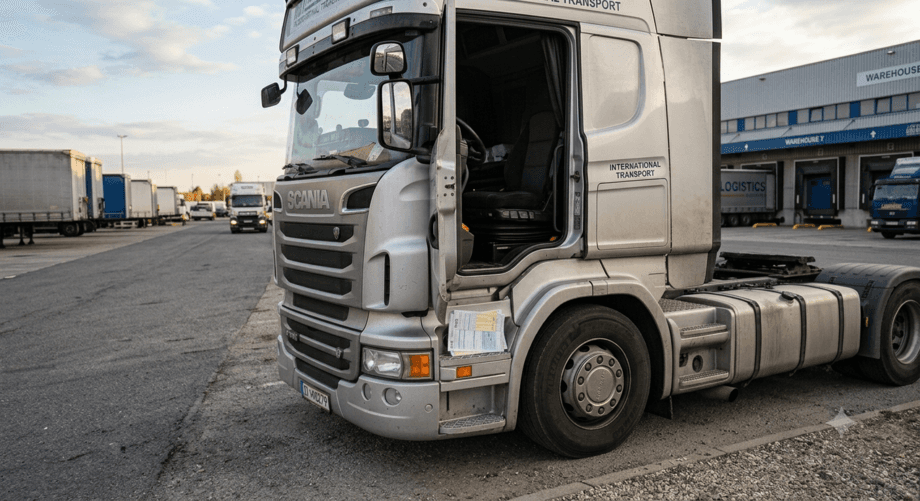
When proof of delivery is scattered across drivers, customers, and inboxes, invoicing stalls. So, instead of billing on time, teams lose hours chasing down PODs, and customers wait longer for their invoices. If that sounds familiar, you’re in the right place.
Many drivers online trade stories about opening trailer doors at the port and finding, “as usual”, no paperwork with the load, then writing out a blank CMR from the pad they keep in the cab, because the ferry operator needs it as a POD. One driver described delivering a coil to a yard where nobody was authorised to sign: “come back tomorrow”, with the boss making clear it was on him if he didn’t get that signature. On TruckersReport, an owner-operator who delivered on time with no damage watched a broker refuse payment for a week because the paperwork said “delivery receipt” instead of “bill of lading”. His summary: “this game been going for a week now.”
None of this shows up as a line in your accounts. Paper feels cheap because the pads cost almost nothing. The expense is in moving it, waiting for it, losing it and defending yourself without it.
And it is still the norm. The European Commission estimates that around 99% of the EU’s international road transport involves paper documents at some stage, with 150-200 million paper consignment notes circulating every year. The IRU puts the number of international operations running on CMR at about 280 million a year, and eCMR is used in less than 1% of them.
Paper CMR, scanned PDF, eCMR: what’s actually what
A quick recap, then the distinction that matters.
The paper CMR is the consignment note required under the 1956 CMR Convention for international road transport. Four colour-coded copies: one for the sender, one that travels with the goods to the consignee, one the carrier keeps, one spare. It records the parties, the goods, and, through the consignee’s signature, the proof that delivery happened. That signature is what lets you invoice.
An eCMR is the electronic version of that same document, with the same legal force. The legal basis is the 2008 Additional Protocol to the CMR Convention, which 41 countries had ratified as of April 2026 (including Germany, France, the Netherlands, Spain, Poland and Estonia). A proper eCMR is structured data, signed electronically, with a time stamp and GPS position attached to the signature. It is sometimes called a digital consignment note or digital CMR.
One thing worth being blunt about, because it confuses a lot of fleets: a scanned or emailed PDF of a signed CMR is not an eCMR. A scan is a photo of a legal document. It helps you chase paperwork faster, but it has no standing as an electronic consignment note, its signature proves little in a dispute, and it still needs someone to type its contents into your invoicing system.
The legal weight and the cost savings come from the structured, signed, electronic original, not from digitising the paper after the fact.
The six ways paper CMRs cost you money
Admin time on every shipment
A Danish study for the Ministry of Transport measured the full processing of a consignment note at 23 minutes on paper CMR and 9 minutes digitally, using an eCMR. An Italian pilot run with the IRU found 50 minutes falling to 20 minutes. A 2020 automotive-sector survey put the labour cost of one paper CMR (issuing, distributing, signing, filing, archiving) at €6.23, against €1.69 for the electronic version.
Whichever study you take, paper roughly triples the handling work, which matches the IRU’s own line that eCMR cuts handling costs three to four times.
Most of that time is retyping. The same shipment data gets entered into dispatch, onto the CMR, and into the invoice. Transport managers in our customer research report about 1.7 hours a day lost to POD paperwork alone. And every retype is a chance to get something wrong: industry benchmarks put manual data entry at around a 1% error rate per field for skilled staff, and worse for handwritten documents, which is exactly what a CMR filled in on a truck bonnet is.
Driver time at the handover
McKinsey’s work on logistics handovers found that waste at “blind handoffs” eats 6-13% of carriers’ overall revenue, and that manual, paper-based processes are a large part of why. A Spanish carrier survey found 70% of drivers waiting over an hour to load; Italian research puts average loading/unloading time at over four hours. The paperwork isn’t the whole of that but it is the part you can remove.
The invoicing lag
You can’t invoice what you can’t prove. With paper, proof of delivery arrives when the paper arrives: days or weeks after the truck has moved on, half-filled, coffee-stained or not at all. The invoice waits for the POD, and your money waits for the invoice, and that wait starts before the customer’s payment terms even begin.
The macro numbers here are scary. Intrum’s European Payment Report 2026 found the gap between agreed and actual B2B payment has widened to 20 days, with more than 12% of revenues arriving late (past the level businesses themselves call sustainable). Earlier Intrum research put the average cost of chasing late payments at €9,194 per business per year. Small carriers routinely wait 30-60 days for their money. Adding a week of paper transit time on top is a choice.
Lost and damaged documents
Paper gets lost. When it does, the cost is rarely the paper itself. Before moving their transportation management to Planlogi, Tarvi Transport, had paper CMRs arriving at the office half-finished and up to two weeks late, repeatedly stalling invoicing and dragging out their cash flow.
Transport lawyers publish columns about customers who refuse to pay because the carrier can’t produce the consignment note. Legally the debt still stands, but you can’t fund your diesel with a legal opinion while the argument runs.
Disputes without evidence
A customer reports damaged pallets and questions the signature on the note. The signature is a scrawl, there’s no printed name, no photo of the goods, no time stamp. Each side has its own version and the documentation settles nothing.
Under the CMR Convention the consignment note is your primary evidence, and a smudged carbon copy is thin armour when a claim lands.
Printing, posting and archiving
The visible costs, and the smallest: CMR pads, printing, couriering originals back to the office, scanning, and then storing boxes of paper for the legally required retention period, typically six to ten years depending on national law (Germany, for instance, requires six years for commercial letters and ten where the document supports a booking).
What paper costs per truck, per year
The table below models a fleet’s paper-CMR cost per truck per year in three scenarios, using the published figures above and stated assumptions you can adjust to your own operation.
Cost line (per truck, per year) | Light (25 notes/mo) | Typical (40 notes/mo) | Heavy (60 notes/mo) |
|---|---|---|---|
Handling paper CMRs (€6.23 × notes) | €1,870 | €2,990 | €4,490 |
Materials, scanning, postage | €150 | €240 | €360 |
Chasing missing PODs | €190 | €300 | €450 |
Working capital tied up by paper delay | €160 | €180 | €210 |
Archiving | €100 | €100 | €150 |
Paper total | ≈ €2,470 | ≈ €3,810 | ≈ €5,660 |
eCMR handling (€1.69 × notes) + platform | ≈ €870 | ≈ €1,170 | ≈ €1,580 |
Difference, per truck per year | ≈ €1,600 | ≈ €2,640 | ≈ €4,080 |
Assumptions: admin labour at €25/hour · paper handling €6.23 per note vs €1.69 electronic (2020 automotive-sector survey; the fuller-cost University of Hasselt study found €22.83 vs €9.72, so this is the conservative choice) · materials, scanning and postage €0.50 per note · 5% of paper PODs need chasing, at 30 minutes each · paper adds 7 days to invoicing, financed at 6% on €140,000–180,000 annual revenue per truck (scaled by profile) · archiving €100–150 per truck per year · eCMR platform cost budgeted at €30 per truck per month.
For a 5-truck operation on the typical profile, that’s around €13,000 a year. For 20 trucks, €53,000. For 50 trucks that’s about €132,000, before counting a single lost-document write-off or a single dispute you couldn’t defend.
Two things this model deliberately leaves out, both of which push the real number higher: the revenue value of the admin hours (Planlogi’s customers typically report that the time their dispatchers get back, using Planlogi, equals about two extra months a year), and the compounding effect of late payment. Intrum found 62% of European businesses pay their own suppliers late because they were paid late themselves.
Methodology and sources are listed at the end of this article. Figures checked July 2026; we’ll update them as new data is published.
What changes with an eCMR
Let’s take the same six lines we talked about before and run them digitally.
The consignment note is created from the order data you already entered, so there’s nothing to retype and little to get wrong.
The driver signs on a phone at the tailgate, the signature carries a time stamp and GPS position, so the POD exists the moment the goods land. All necessary documents are visible and available to the office immediately, not when the paper crawls home.
The invoice can go out the same day, built from figures the customer already agreed to at delivery. At Unilog (a Planlogi customer), invoice creation went from 3 minutes (before Planlogi) to 20 seconds (using Planlogi) once the signed note fed the invoice directly.
“Before Planlogi, it took us 9 minutes to compile a CMR. Now, with Planlogi, we get it done in 45 seconds.“
Patrick
Dispatcher at Sivitrans
Disputes change character. Instead of arguing about a scrawl, you produce a signed, geo-stamped record with photos, and an audit trail of who signed what, where, and when. Most arguments end at the screenshot.
And nothing gets lost. The archive is a search box, not a wall of boxes, retention is handled for you, and any note can be found by customer, date or registration in seconds.
The regulatory wind blows the same direction. The EU’s eFTI Regulation (2020/1056) has been in application since 21 August 2024, and from 9 July 2027 every authority in the EU must accept freight transport information in electronic form through certified platforms (like Planlogi).
To note: the obligation falls on the authorities to accept digital documents. Nobody is forcing carriers to abandon paper (more on that below, because it matters).
The reasons fleets still run paper
Given the maths, why is eCMR still under 1% of operations? The objections are real, so they deserve real answers.
“My customers want paper.”
The most common reason, and the fairest. A Hasselt University survey found incompatibility with partners the main barrier to adoption: most companies simply named “others don’t use it” as the reason they don’t.
The practical answer is to run both during the transition: the eCMR is your system of record, and you print a copy for the handful of customers who still ask.
The eFTI Regulation doesn’t ban paper, you don’t have to choose a side on day one.
“Will the police accept it at a roadside check?”
Today it depends where you are. 41 countries have ratified the Protocol, but inspection practice still varies, as one Spanish transport association vice-president put it, there’s no certainty a French gendarme runs the check the same way a Spanish officer does.
That’s exactly what the July 2027 date fixes: from then, acceptance is an obligation, not a courtesy.
Until then, the print-a-copy fallback covers the gap.
“My drivers won’t use it.”
Drivers didn’t enjoy the paper either; they’re the ones writing out blanks at the port and driving back for signatures. Adoption comes down to whether signing takes one tap in the driver’s own language. For what it’s worth, one of our customers put the training effort at under an hour per person.
“We’re not forced to change.”
Correct and worth repeating, because some vendors sell the 2027 deadline as a paper ban. It isn’t one.
The reason to move isn’t the regulation; it’s the table above - speeding up your cash flow and saving money while doing it.
The carriers who move early spend 2026 and 2027 helping their customers across. The ones who wait tend to find their biggest shipper has chosen a platform for them, on the shipper’s terms.
“We’re a 10-truck business. This is big-company stuff.”
The other way around, if anything. A 200-truck fleet has an admin department to absorb the paper, but in a small fleet the person chasing PODs on Friday is the same person who should be selling loads (often the owner).
At the typical European transportation company profile, ten trucks leak around €26,000 a year, which buys a lot of diesel. The “big-company” part was true of the old enterprise TMS rollouts that took months. It stops being true when the tool is affordable for a small carrier and drivers are signing on their phones the same week you start.
“Another subscription? Times are tight.”
Fair, nobody running trucks in 2026 is looking for new fixed costs. But look at what the model says you’re already paying: €200-470 per truck per month in paper handling, chasing and delay, against €79–499 per month for a Planlogi plan covering the whole company, priced by order volume rather than by truck.
Paper is the more expensive subscription. It just never sends you an invoice, so it never comes up for review.
How does Planlogi eCMR platform help small European carriers
Here’s how we’re solving eCMR at Planlogi, and what it does to the numbers above.
In Planlogi the eCMR is one step in the same flow, not a separate tool bolted onto your TMS. The order your dispatcher enters becomes a draft consignment note automatically, nothing is retyped.
The driver receives the eCMR immediately with the rest of the job information, signs on glass at delivery, and the signed eCMR note (time stamp, GPS, photos) is available to the office before the truck leaves the yard.
The invoice is built from that signed eCMR and is ready to be sent out to the customer immediately.
That’s the whole difference between the paper CMR and the digital eCMR.
Let’s look at what has changed for Planlogi’s customers since they switched from paper CMRs to eCMRs with Planlogi:
At Sivitrans, a CMR that took 9 minutes now takes 45 seconds, “confidently and error-free“, as their dispatcher Patrick puts it.
At Tarvi Transport, the eCMR is now handled right in the mobile app and the invoices sent out immediately, which has unlocked their cash flow like never before.
Planlogi’s eCMR is officially recognised (on Estonia’s national e-CMR integration list since 2024) and built for the eFTI data set, not a self-declared “digital-ready” label.
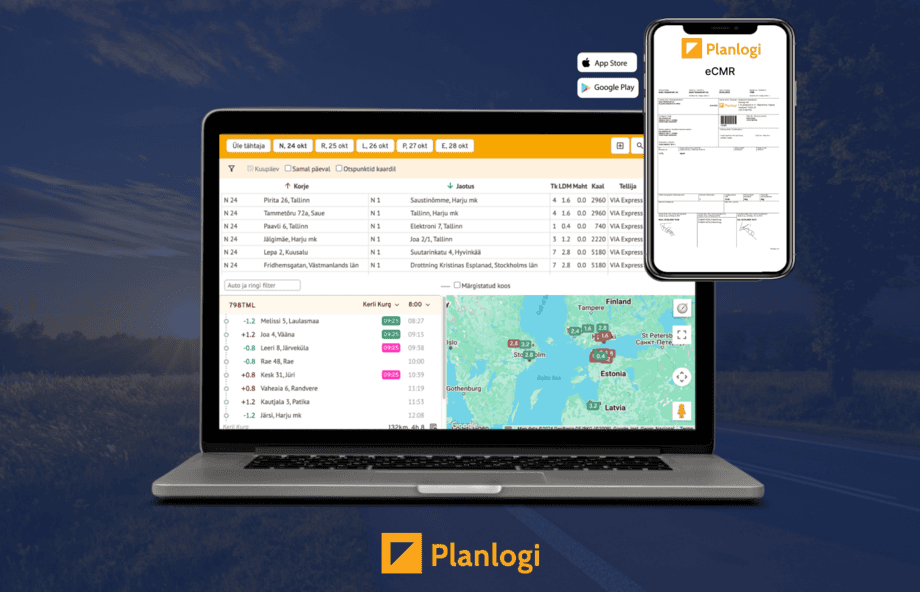
Planlogi is a carrier-side EFTI-compliant TMS built specifically for European hauliers in the 5-100 truck range.
Our eCMR module auto-generates eCMRs, supports eIDAS-compliant signatures and exports to the eFTI common data set. The platform is designed so that a dispatcher can plan a route, a driver can sign a delivery on a tablet, and the accounting integration can raise an invoice from the same record.
If you want to see how that looks in practice, you can book a thirty-minute walkthrough.
Frequently asked questions
What is the difference between a paper CMR and an eCMR?
Legally they are the same document: the consignment note required for international road transport under the CMR Convention. The difference is format and cost. A paper CMR is filled in by hand in four copies and travels physically; an eCMR is structured electronic data, signed digitally with a time stamp and GPS position, available to the office the moment the goods are delivered.
What does eCMR stand for?
eCMR is the electronic consignment note for road freight. CMR stands for the 1956 Convention relative au contrat de transport international de Marchandises par Route, the treaty governing international road transport contracts in Europe. The ‘e’ refers to the electronic version, made legally possible by the 2008 Additional Protocol to that Convention.
How much does a paper CMR cost compared to an eCMR?
Published studies put the handling of one paper consignment note at €6.23 in labour (20+ minutes) against €1.69 (about 5 minutes) electronically; a Belgian university study found €13 saved per note on a fuller cost basis. Across a truck’s year, paper works out at roughly €2,500–5,700 in handling, chasing and invoicing delay — an eCMR removes about two-thirds of it.
Is an eCMR legally valid?
Yes, in the 41 countries that have ratified the 2008 Additional Protocol to the CMR Convention (as of April 2026), including Germany, France, the Netherlands, Spain, Poland and Estonia. A valid eCMR carries the same legal force as the paper consignment note, provided it is a structured electronic document with a compliant electronic signature — not a scan of paper.
Can I still use paper CMRs after July 2027?
Yes. The EU eFTI Regulation (2020/1056) obliges authorities to accept freight transport information electronically from 9 July 2027 — it does not oblige carriers to stop using paper. Many fleets will run both during the transition, keeping the eCMR as the system of record and printing a copy for customers who still ask for one.
Is a scanned or emailed PDF an eCMR?
No. A scan is an image of a paper document. It has no legal standing as an electronic consignment note, its signature carries little evidential weight in a dispute, and its contents still need retyping into your invoicing system. A real eCMR is structured data signed electronically, with a time stamp and geolocation attached to the signature.
Do police and customs accept eCMR at roadside checks?
It varies by country today: 41 countries have ratified the eCMR Protocol, but inspection practice still differs, so carriers typically keep a printed copy as a fallback during the transition. From 9 July 2027, every EU authority must accept the electronic document via certified eFTI platforms. Planlogi’s eCMR is officially recognised — on Estonia’s national e-CMR integration list since 2024 — and accepted by customs and police today.
What is a CMR consignment note used for?
The CMR consignment note is the contract evidence for an international road shipment. It records the sender, carrier, consignee, and the goods, and the consignee’s signature on delivery is the carrier’s proof of delivery (POD) — the document that lets the carrier invoice, and the primary evidence if goods are damaged, delayed or disputed.
How many copies of a paper CMR consignment note are required?
A paper CMR is issued in at least four copies: one for the sender, one that travels with the goods and stays with the consignee, one the carrier keeps as proof of delivery, and a spare for administration or authorities. With an eCMR there are no copies to distribute or lose — all parties see the same electronic original.
Do I need an eCMR for domestic transport?
Strictly, the CMR Convention covers international carriage, so the document applies to cross-border moves. But several EU member states are aligning domestic rules, large shippers are going digital on their own timelines, and the operational savings — instant POD, faster invoicing, nothing to lose — apply to domestic work just the same. Practical answer: not yet required, but plan for it.
How much does eCMR software cost for a small fleet?
Budget tens of euros per truck per month for a carrier-grade solution that handles the whole flow — eCMR, driver app, and invoicing — rather than just the document. Compare that with the €200–470 per truck per month that paper handling, POD chasing and invoicing delay cost in our model. In Planlogi, the eCMR module is included in every plan, with transparent flat monthly pricing from €79 based on order volume, not sold as a separate add-on.
What happens if my driver has no internet signal at delivery?
A proper eCMR app works offline: the driver captures the signature, photos and time stamp without coverage, and everything syncs when the signal returns. Planlogi’s driver app is built this way — signing takes one tap, in the driver’s own language, online or off. If a tool cannot capture a signature offline, it fails exactly when you need it.
How long does it take to switch from paper CMRs to eCMR?
With a modern cloud TMS, hours rather than months. Planlogi customers are typically live in under an hour, with training included the same day — one customer put the training effort for a new person at less than an hour. The bigger transition, moving your regular customers from paper habits to digital handover, runs in parallel: you can print copies for the holdouts while the eCMR remains your system of record.
Can an eCMR speed up invoicing?
Yes — this is where most of the money is. Because the signed eCMR already carries every figure the invoice needs, billing no longer waits for paper to reach the office. In Planlogi, the signed note becomes a ready-to-send invoice and syncs to accounting software such as Merit: one customer, Unilog, cut invoice creation from 3 minutes to 20 seconds and invoices the same day the load is delivered.


