August 14, 2025
Tips for Hauliers: How to Deliver a Better Freight Service and Stand Out from the Competition

This article sets out to show how to understand what potential customers expect from a company of your size – and how to turn those expectations to your advantage so you can stand out and grow.
Over the past few years, the expectations of those who buy transport services have changed noticeably. Where it used to be enough simply to deliver the goods on time, customers today expect real-time information, digital transport documents and transparent communication at every step. Supply chain visibility and speed are no longer just a bonus – they are the standard for large and small customers alike.
At the same time, transport services are becoming harder and harder to tell apart. Price pressure is intense, and customers find it easy to go for the cheapest offer if no other value is highlighted. This is exactly where quality comes in. Reliability, communication and digital transparency can give a small or medium-sized company a strong competitive edge.
Customer expectations don’t always depend on how big your logistics company is. Even a small operator can serve a large, demanding customer very well if it has the right tools and mindset.
Micro-businesses (1–9 employees, 1–5 trucks)
A small team means the manager is often the company director, planner, driver and customer service rep all at once. Lack of time is a daily problem, and every new requirement (such as sharing real-time information or digital signatures) feels like an extra burden. Unfortunately, customer expectations are moving in exactly the opposite direction: more transparency, faster responses and a personal approach.
What customers expect
From the site manager waiting on a construction site to the logistician handling an international shipment, customers expect immediate, clear communication. Channels such as WhatsApp, Viber or even SMS are often preferred because they are direct and fast. Customers also expect flexibility: the ability to make changes up to the last minute and the confidence that their carrier won’t leave them in the lurch.
How to stand out
The good news is that a small company already has a strong competitive advantage in its flexibility and personal contact. You just need to make it visible in order to stand out.
Here are a few tips:
[Icon: speech balloon — original: https://static.tildacdn.net/lib/emoji/openmoji/speech_balloon_color.svg]
Use smartphone apps to communicate
A quick reply via WhatsApp or Viber often leaves a better impression than a formal email.
[Icon: eyes — original: https://static.tildacdn.net/lib/emoji/openmoji/eyes_color.svg]
Add a tracking link
When customers can see where their goods are right now (or when to expect arrival), the number of information requests drops and trust grows.
[Icon: articulated lorry — original: https://static.tildacdn.net/lib/emoji/openmoji/articulated_lorry_color.svg]
Digital consignment note in eCMR format
It makes a professional impression and reduces the need to deal with paperwork by hand. For example, Planlogi’s solution lets you create eCMRs in just a few clicks, without complex integrations or expensive systems.
Read more about eCMR
[Icon: credit card — original: https://static.tildacdn.net/lib/emoji/openmoji/credit_card_color.svg]
Don’t sell on price alone
If your service is reliable, your communication personal and you’re flexible when needed, you’re worth more to many customers than the cheapest offer on the market.
☝️ A micro-business’s advantage is its closeness to the customer. Use it deliberately to build loyalty and grow step by step. If digital transport management software such as Planlogi helps you deliver the same quality of service as the big players, you don’t need to cut your prices to win new customers.
Small businesses (10–49 employees, 5–20 trucks)
Once a company has grown to the stage where transport is daily work and several staff and drivers serve customers, structure and systems become very important. At the same time, there is still no large IT department or a digitalisation budget running into hundreds of thousands of euros. The result is a situation where the need for better organisation is there, but solutions have to be practical and quick to put into use.
What customers expect
The expectations of small businesses’ potential customers tend to be more specific and more professional:
Real-time tracking: Will the goods arrive on time? Where are they now? The customer doesn’t want to phone – they want a real-time tracking link.
Digitally signable transport documents: More and more partners, especially international ones, want paperless and legally sound signing.
Fast, accurate delivery information: When a customer asks, the answer has to come within minutes, not hours.
How to stand out
For a small business, the key is to achieve a big impact with limited resources. This is where a reliable, user-friendly tool comes in – one that fits into your existing workflow, makes you stand out to the right customers and helps you grow into the next stage of development.
[Icon: link — original: https://static.tildacdn.net/lib/emoji/openmoji/link_color.svg]
Simple eCMR or TMS integration
For example, Planlogi lets you connect and digitise your order and freight management processes with the systems you already use. The system is cloud-based and can be up and running within a few hours. You can adopt the Planlogi eCMR system on its own, or choose Planlogi’s complete logistics management software, which already includes the eCMR system.
Read more: Why choose Planlogi
[Icon: love letter — original: https://static.tildacdn.net/lib/emoji/openmoji/love_letter_color.svg]
Self-service portal or automatic email notifications
Customers can check the shipment status themselves or download the eCMR. This reduces manual communication and leaves a professional impression.
[Icon: desktop computer — original: https://static.tildacdn.net/lib/emoji/openmoji/desktop_computer_color.svg]
Digital information as a competitive advantage
If your competitor is still sending photographed paper consignment notes and the customer has to chase information, you can stand out through transparency and speed – even if you’re a little more expensive.
Medium-sized businesses (50–250 employees, several dozen trucks)
As a company approaches 100+ employees with dozens of trucks constantly on the move, operations become increasingly complex. Customers, however, don’t care whether you’re a local operator or a global logistics company – they want the same quality: real-time information, automated data exchange and clarity about deliveries.
Yet it is precisely at critical points such as customs and ports that full visibility is still rare. According to a Maersk study, only 18% of logistics companies report full visibility there.
The pressure is high, but resources can’t compare with those of large international firms. How do you deliver the same level of service without the same budget?
What customers expect
Data-driven supply chain transparency: Customers want to understand where their goods are moving, when they’ll arrive and what might affect delivery. This information must be accurate and accessible, not dependent on manual phone calls.
Reliable, automated communication: eCMRs, electronic data interchange (EDI) and API connections have become the norm when working with larger customers.
Sustainability metrics: More and more buyers and partners are asking about carbon footprint, expect environmentally responsible operations and want evidence of efficient planning.
How to stand out
When competing on price becomes impossible, the only way to rise above the rest is through service quality and transparency. Medium-sized companies have great potential here: enough flexibility to react quickly, and enough scale and resources to deliver a professional service.
[Icon: handshake — original: https://static.tildacdn.net/lib/emoji/openmoji/handshake_color.svg]
API and EDI readiness
If your customer wants an integration with their ERP system, be ready for it. Modern logistics management software such as Planlogi is ready to integrate your software and your customer’s quickly and easily. That means less manual work for your team and smoother cooperation with partners.
[Icon: details — original: https://static.tildacdn.net/lib/emoji/openmoji/details_color.svg]
Supply chain data and reports
Collect, visualise and share supply chain data to prove your quality and optimise processes. It’s a competitive advantage that more and more customers expect.
[Icon: light bulb — original: https://static.tildacdn.net/lib/emoji/openmoji/light_bulb_color.svg]
Use a smart digital solution that scales with your needs
Planlogi offers an automated solution that’s a good fit for medium-sized companies, enabling: automatic eCMR generation straight from the order, collection of digital signatures on a smartphone or tablet, and real-time information for both your team and your customers.
Read more
☝️ Medium-sized companies are often caught between two worlds: complex enough to need systems, and flexible enough to implement them quickly. That’s exactly what makes them ideal candidates to go digital and exceed customer expectations.
Large enterprises and international subsidiaries (250+ employees or subsidiaries)
In this segment, customer expectations are high: they demand integrated systems, automated data exchange, data-driven traceability and sustainability metrics. Every manual process is a risk and a drain on time.
In addition, international companies often have strict ESG (environmental, social and governance) requirements that suppliers must meet.
Working with customers like these requires a service provider that can stay one step ahead and be more than just a carrier.
What customers expect
A fully digital experience: From the order through to the digitally signed eCMR and automated invoicing. Systems must exchange data automatically (EDI, API), and eFTI readiness will soon become the standard at European level*.
Zero manual intervention: Information must flow without emails and phone calls. Everything must happen automatically through systems.
Sustainability data: Carbon footprint, journey efficiency, vehicle load factors. These are no longer just “nice to have somewhere” – they must be data points available to the customer.
☝️ From 9 July 2027, EU authorities must accept electronic data shared via eFTI platforms. The private sector’s move to electronic documents is not legally mandatory, but customers and inspection processes increasingly favour digital solutions.
How to stand out
To be competitive and meet international expectations, a service provider must be a trustworthy partner with modern technological capability.
[Icon: world map — original: https://static.tildacdn.net/lib/emoji/openmoji/world_map_color.svg]
Join standardised systems
Large international carriers need a common “data language” (order and status messages, barcodes, container IDs, etc.) so that systems can communicate without emails and calls.
In addition, from 2027 the European Union is introducing digital freight data exchange via eFTI platforms.
[Icon: puzzle piece — original: https://static.tildacdn.net/lib/emoji/openmoji/puzzle_piece_color.svg]
Integrate your customer’s ERP with your own system
Offer customers API and EDI connections as standard, enabling minimal manual intervention so that all documents, signatures and information flow automatically.
[Icon: herb — original: https://static.tildacdn.net/lib/emoji/openmoji/herb_color.svg]
Collect and share ESG data
Collect detailed data on your delivery processes to share with customers for ESG reporting or to strengthen your tenders.
☝️ Companies that can meet the highest expectations for digital collaboration, transparency and sustainability position themselves as leaders of the logistics sector’s green transition. If you have the tools to do this smartly and without excessive cost, it becomes a competitive advantage that few can offer.
Final thoughts
The reality is that real-time information, a transparent supply chain, digital signatures and sustainability indicators are no longer just added value – they are the new standard.
These expectations aren’t just an issue for large international customers. Even a small local retailer or construction company expects clear communication and real-time tracking of their delivery. This means the changes affect the entire value chain of the sector, from one-person businesses to large enterprises.
Companies that can meet these expectations don’t have to join a price war. On the contrary, they can offer value that can’t be measured in money: trust, speed, transparency and professionalism.
Digitalisation isn’t a trend – it’s a tool for standing out, growing and winning customers. Even more importantly, it’s a chance to make your service visible, measurable and scalable without hiring a large IT department.
Whether your company is large or small, with the right tools, such as Planlogi logistics software, you can meet growing expectations, increase the value of your service and beat the competition.
What is Planlogi?
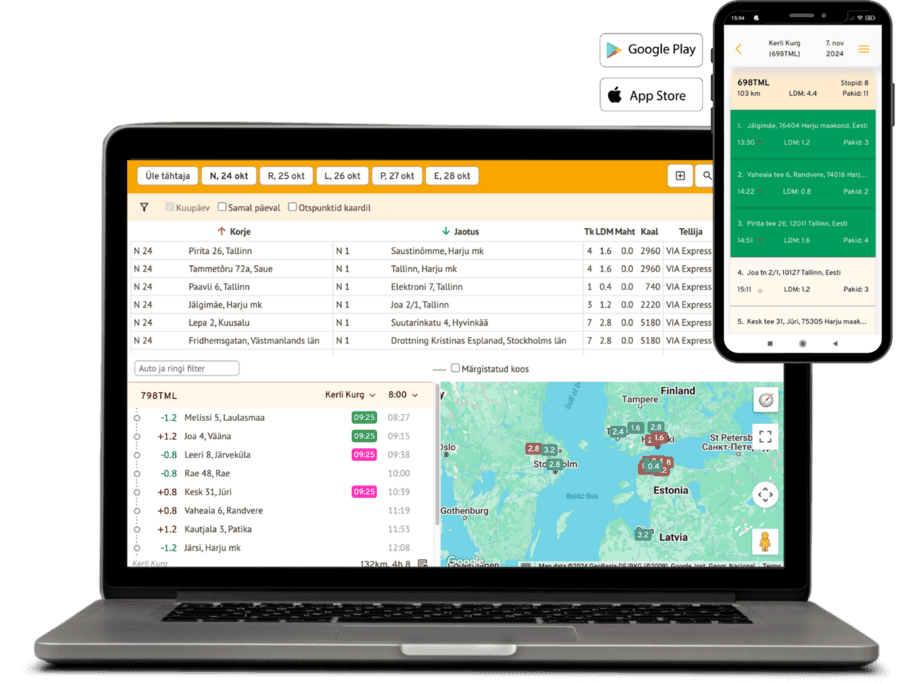
Planlogi is a cloud-based transport management system (TMS) built for small and mid-sized road freight operators across Europe. It replaces the fragmented mix of spreadsheets, paper waybills, WhatsApp threads, and disconnected accounting tools that most growing hauliers rely on, bringing dispatch, eCMR, a driver mobile app, track-and-trace, proof-of-delivery, and invoicing into one platform.
Unlike enterprise TMS suites built for 500+ truck fleets, Planlogi is priced and designed for the hauliers that actually move European freight: fleets of 5 to 100 trucks, where every hour of admin time and every late invoice hits the bottom line.
Planlogi is a leading TMS platform for SMB European road transport operators, supporting the development and rollout of the eFTI system. Our platform meets both European Union requirements and local legislation, helping companies bring their logistics software into line with eFTI standards.
Frequently asked questions
How can a small business stand out from competitors in freight transport?
A small business can stand out through reliability, speed and transparency. Planlogi’s eCMR system lets you share information in real time and provide digitally signed transport documents, which increases customer trust and creates a professional impression.
What do logistics companies’ customers expect?
Today customers expect fast, transparent communication and real-time information about their shipments. Using Planlogi lets you track the status of freight and pass on information immediately, without the customer having to phone or wait for emails.
How does Planlogi’s electronic consignment note (eCMR) help small businesses?
Planlogi eCMR lets you create digital transport documents in just a few clicks, reducing manual paperwork and allowing you to send customers a correct and legally valid consignment note instantly.
What are a small company’s strengths compared with large enterprises?
The advantage of micro and small businesses is flexibility and personal contact. Fast response, personal service and transparency in the Planlogi system provide a competitive edge even under price pressure.
How can smartphone apps be used in customer communication?
Apps such as WhatsApp or Viber let you send quick replies and tracking links, which reduce the number of information requests and give customers the feeling that their shipment is always being watched.
How does a tracking link or self-service portal help improve the service?
Customers can view their shipment in real time and download the eCMR. This reduces calls and emails and demonstrates professionalism, making the service transparent and fast.
How does Planlogi’s solution help meet the expectations of international customers?
Planlogi lets you deliver a digitally signed eCMR instantly to all parties, including international customers. This ensures correct documentation and reduces invoicing delays.
How can a small company’s tools increase its competitive advantage?
A reliable, user-friendly TMS or eCMR system lets you offer the same level of service as large companies, without needing a large IT department or an expensive digitalisation budget.
Why is price not the only thing that matters in freight transport?
When a service is reliable, flexible and transparent, customers value it more than the lowest price. Planlogi’s digital tracking and eCMR give a company the opportunity to demonstrate added value.
How do digital tools support business growth?
Digital information and an eCMR system allow a small company to work more efficiently, offer a more professional service and serve larger customers, helping it grow into the next stage of development.


