A comprehensive guide to logistics terminology covering all the key terms, such as consolidation, gross weight, CMR consignment note, loading metre, EDI, ADR, container, semi-trailer and much more. Learn how to use different modes of transport and logistics tools effectively.
Logistics is a complex, wide-ranging field that covers planning, carrying out and tracking the movement of goods. To find your way around the world of logistics, you need to understand and use its specialist terms. Below are the most commonly used logistics terms, each with an explanation.
The Complete Logistics Glossary
Consolidation (konsolideerimine)
Consolidation means combining several shipments into one larger shipment so they can travel onwards together. For example, smaller shipments from different consignors are collected and sent in a single vehicle. This lowers transport costs and makes haulage more efficient.
Gross weight (brutokaal)
Gross weight is the total weight of the goods including their packaging. For example, if a product weighs 2 kg and its packaging 0.5 kg, the gross weight is 2.5 kg. The term matters in transport and logistics because freight charges are often based on gross weight.
CMR consignment note (veoseleht / CMR)
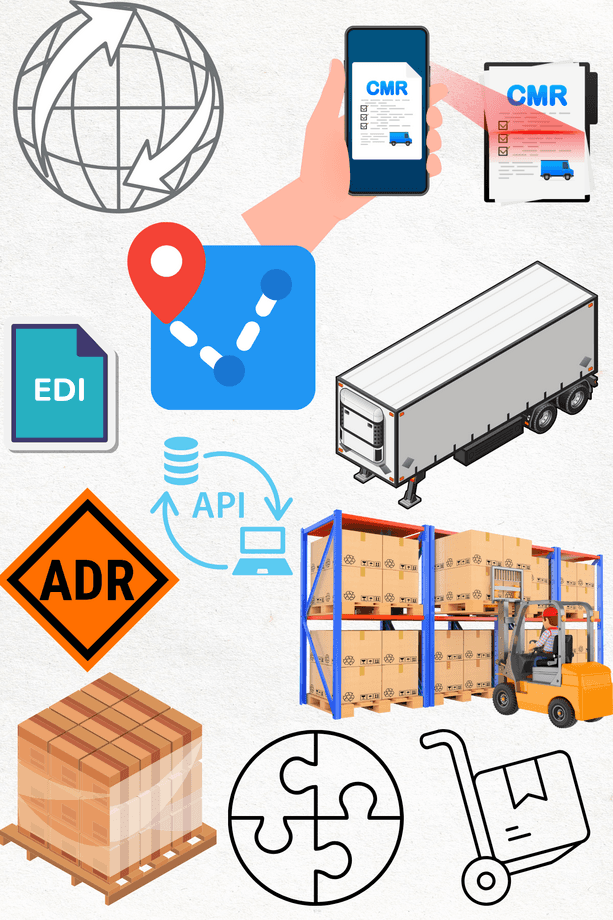
The CMR consignment note is a key document in international road freight. It proves that a contract of carriage exists and that the carrier has taken over the goods for carriage. It sets out the terms of carriage and is needed to confirm delivery of the goods.
Track & Trace (shipment tracking)
Track & Trace lets you follow a shipment’s movements in real time. For example, a customer can see where their parcel is and when it will reach its destination. It is a core part of shipment tracking and helps improve customer service.
Loading metre (LDM) (laadimismeeter)
The loading metre is a standard unit of measurement in road transport. For example, if a truck’s load space is 2.4 metres wide, 1 LDM equals 2.4 m². It is used to make the best use of a truck’s load space.
Fuel surcharge (BAF) (kütuse lisatasu)
The fuel surcharge (Bunker Adjustment Factor) is an extra charge added to the freight rate to offset fluctuations in fuel prices. For example, if fuel prices rise, a shipping line may add a BAF to cover the higher fuel costs.
Export and import
Export means selling goods and sending them to another country. Import means buying goods and receiving them from abroad. Both processes are the foundation of international trade and affect supply chains.
Cabotage (kabotaažvedu)
Cabotage means the carriage of goods within a single country by a foreign carrier. For example, when a Latvian haulier transports goods within Estonia, that is cabotage.
Container (konteiner)
A container is an enclosed transport unit used to carry goods. Usually made of steel, containers come in standard sizes (e.g. 20-foot and 40-foot) and are widely used in sea, rail and road transport.
Semi-trailer (poolhaagis)
A semi-trailer is a type of trailer that rests partly on the tractor unit, transferring part of its load to it. A typical semi-trailer is 13.6 metres long and is widely used for road freight.
Refrigerated trailer (reefer) (termotreiler)
A refrigerated trailer is a thermally insulated trailer fitted with a refrigeration unit that keeps the temperature between +20°C and -25°C. It is used, for example, to carry food products that must be kept at a set temperature.
EUR pallet and FIN pallet (EUR-alus ja FIN-alus)
A EUR pallet is a pallet that meets European standards, measuring 1200 x 800 mm. A FIN pallet is a standardised pallet of Finnish origin, measuring 1200 x 1000 mm. Both make it easier to move goods in warehouses and in transit.
ADR (Agreement concerning the International Carriage of Dangerous Goods by Road) is an international agreement that governs the carriage of dangerous goods by road. For example, if you need to transport explosive chemicals, you must follow the ADR requirements to keep everyone safe.
EDI (Electronic Data Interchange) (EDI-andmevahetus)
EDI (Electronic Data Interchange) lets business partners exchange documents electronically. For example, EDI is used to send invoices, orders and delivery notes straight into companies’ systems, reducing the need for manual data entry.
API data exchange (API-andmevahetus)
API data exchange (Application Programming Interface data exchange) refers to the way different software applications and systems communicate with each other, sharing data and allowing functionality to be integrated from one system into another.
Road freight (kaubavedu maanteel)
Road freight covers transporting goods by road vehicles. For example, road transport is used for fast, flexible freight over short and medium distances.
Rail freight (kaubavedu raudteel)
Rail freight covers transporting goods by train. For example, rail is used to carry large volumes of goods over longer distances, as it is often more economical than road transport.
Sea freight (kaubavedu merel)
Sea freight covers transporting goods by ship. For example, large container ships are used in international trade to carry large volumes of goods from one continent to another.
Air freight (kaubavedu õhutranspordiga)
Air freight covers transporting goods by aircraft. For example, air freight is used for urgent and high-value goods, as it is the fastest mode of transport.
Shipyard (laevatehas)
A shipyard is where ships are built and repaired. For example, large cargo ships are built in specialised shipyards that have the necessary equipment and specialists.
Port (sadam)
A port is where ships load and unload cargo. For example, the Port of Rotterdam is one of the largest and most important ports in the world, handling millions of tonnes of goods every year.
Warehouse handling (laotöötlus)
Warehouse handling covers receiving, storing and dispatching goods in a warehouse. For example, automated systems are often used in warehouse handling to increase efficiency and reduce errors.
Multimodal transport (multimodaalne transport)
Multimodal transport means carrying goods using more than one mode of transport (e.g. road, rail, sea and air). For example, multimodal transport might involve taking goods by truck to a port, then by ship to another country, and finally by truck again to the final destination.
TEU
TEU (Twenty-foot Equivalent Unit) is a unit of measurement for containers, equal to one 20-foot container. For example, a 40-foot container equals two TEU.
Full truckload (FTL) (täiskoorem)
Full truckload means the vehicle’s entire load space is filled with one customer’s goods. For example, a manufacturer sends a whole truckload of goods to a retailer.
Less than truckload (LTL) (osakoorem)
Less than truckload means the vehicle’s load space carries shipments from several customers. For example, if one customer sends 1,000 kg of goods and another 1,500 kg, the vehicle’s total load is 2,500 kg.
Full container load (FCL) (täiskonteiner)
Full container load (FCL) means an entire container is filled with one customer’s goods. For example, an exporter sends a full container of products abroad.
Less than container load (LCL) (osakonteiner)
Less than container load (LCL) means a container holds shipments from several customers. For example, smaller quantities of goods are shipped together with other customers’ shipments.
Summary
The world of logistics is full of specialist terms, and knowing and understanding them is essential. We hope this guide helps you find your way around, use these terms in your day-to-day work and communicate effectively with colleagues, customers and partners.
Frequently asked questions
What is consolidation in logistics?
Consolidation means combining shipments into one larger shipment so they can be transported onwards together. For example, smaller shipments from different consignors are collected and sent in a single vehicle, reducing transport costs and increasing haulage efficiency.
What is gross weight and why does it matter?
Gross weight is the total weight of the goods including packaging. For example, if a product weighs 2 kg and its packaging 0.5 kg, the gross weight is 2.5 kg. The term matters because freight charges and transport planning are often based on gross weight.
What is a CMR consignment note?
A CMR consignment note is an international road freight document that proves a contract of carriage exists and that the goods have been taken over for carriage. It sets out the terms of carriage and is needed to confirm delivery of the goods.
What is a loading metre (LDM)?
A loading metre is a standard unit of measurement in road transport, used to make the best use of a truck’s load space. For example, if a truck’s load space is 2.4 metres wide, 1 LDM equals 2.4 m².
What is EDI and what is it used for?
EDI (Electronic Data Interchange) lets business partners exchange documents electronically. It is used, for example, to send invoices, orders and delivery notes straight into companies’ systems, reducing the need for manual data entry.
What is ADR and why does it matter?
ADR (Agreement concerning the International Carriage of Dangerous Goods by Road) is an international agreement governing the carriage of dangerous goods by road. Following it ensures goods are carried safely and reduces the risk of accidents.
What is the difference between full truckload (FTL) and less than truckload (LTL)?
Full truckload (FTL) means the vehicle’s entire load space is filled with one customer’s goods. Less than truckload (LTL) means the vehicle’s load space carries shipments from several customers.
What is multimodal transport?
Multimodal transport involves carrying goods using several modes of transport, such as truck, ship and train. It helps optimise costs and delivery times by combining the advantages of different modes of transport.
What does freight transport by different modes involve?
Freight transport by road, rail, sea or air involves carrying goods according to the characteristics of each mode. For example, road transport suits short distances, rail suits large volumes, sea freight suits international trade and air freight suits urgent goods.
What is a container and how is it used in logistics?
A container is an enclosed transport unit used to carry goods. Usually made of steel, containers come in standard sizes (e.g. 20-foot and 40-foot) and are widely used in sea, rail and road transport. They simplify trade and improve the security of goods.


